A Complete Guide to Standard Envelope Dimensions
Published on
Picking the right envelope doesn't need to be complicated. Once you get the hang of the standard UK sizes, it’s actually pretty straightforward. The big three you'll come across most often are DL, C5, and C4, each one perfectly sized to fit standard A-series paper. This simple system takes the guesswork out of the equation and makes sure everything looks sharp and professional.
Quick Reference for UK Envelope Dimensions
If your business sends out physical mail for marketing or everyday comms, you'll know how important it is to get the envelope size right. Here in the UK, we mostly use the ISO 216 C-series, which cleverly corresponds with A-series paper sizes. It's a brilliantly logical system: an A4 sheet slides neatly into a C4 envelope, an A5 into a C5, and so on. No more forcing paper in or having it rattle around.
Then there's the trusty DL envelope, an absolute staple for any business. Measuring 110 x 220 mm, it’s designed to hold a sheet of A4 folded into three equal parts, making it the go-to for letters, invoices, and flyers.
To make things even easier, here's a quick look at how the most common sizes stack up.
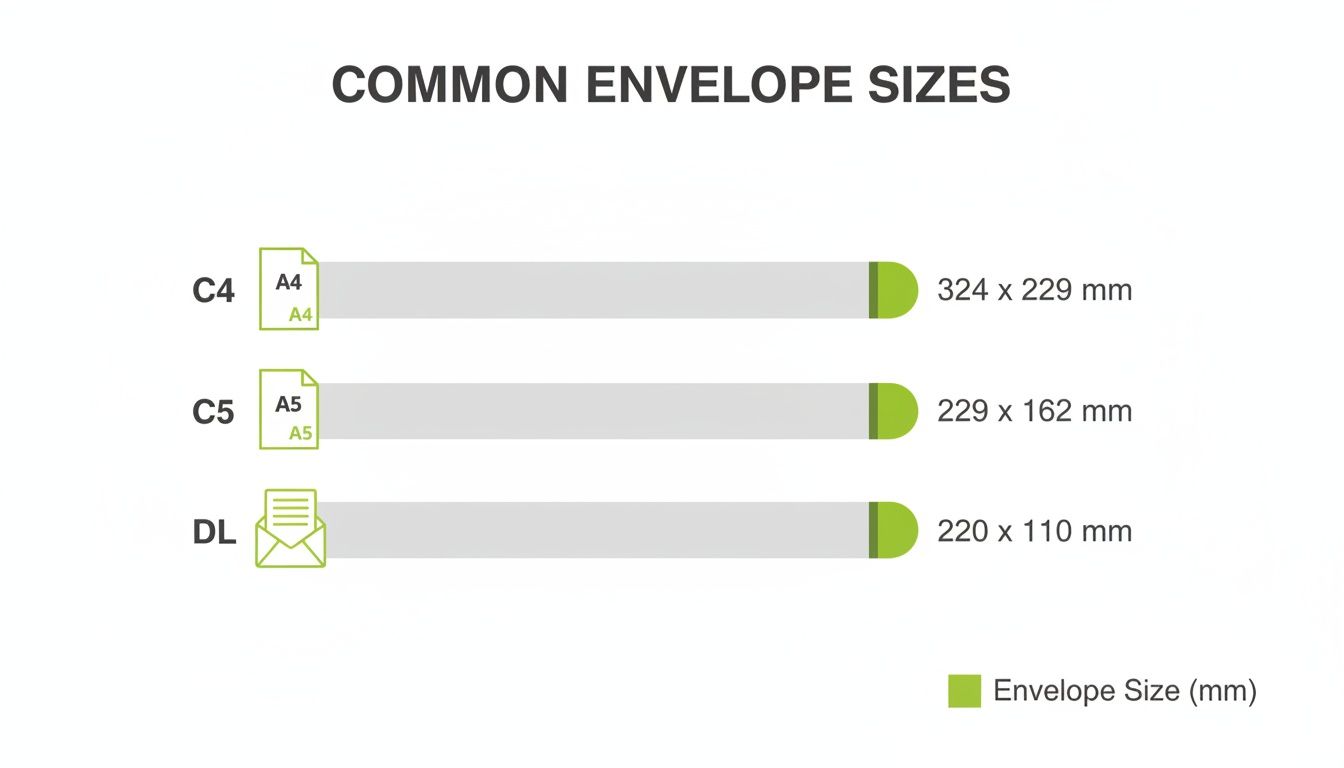
As you can see, each size has its job. A C4 is perfect for sending unfolded A4 documents like contracts or certificates, while a DL is your everyday hero for folded letters. And while these are the ones you'll see most, there are plenty of other sizes for more specific needs. If you're curious about less common options, you can read our guide on the size of a 6 envelope.
UK Standard Envelope Dimensions at a Glance
For a quick and easy comparison, here are the vital statistics for the most popular UK envelope sizes all in one place.
| Envelope Size | Dimensions (mm) | Dimensions (inches) | Fits Paper Size |
|---|---|---|---|
| C4 | 229 x 324 mm | 9.0 x 12.8 in | A4 (unfolded) |
| C5 | 162 x 229 mm | 6.4 x 9.0 in | A5 / A4 (folded) |
| C6 | 114 x 162 mm | 4.5 x 6.4 in | A6 / A5 (folded) |
| DL | 110 x 220 mm | 4.3 x 8.7 in | A4 (folded 1/3) |
Bookmark this table, and you'll never have to second-guess which envelope to order for your A4, A5, or A6 print materials again. It's all about matching the 'C' to the 'A' or grabbing a DL for your standard letters.
Understanding ISO C-Series Envelope Sizes
Here in the UK and across Europe, the C-series is the gold standard for envelopes. It’s all governed by the ISO 216 standard, but don't let that sound complicated the system is brilliantly logical. It’s designed to work hand-in-glove with the A-series paper sizes we all use daily, from A4 letters to A6 postcards. Get your head around this relationship, and you'll pick the right envelope every single time.
The basic idea is a perfect fit. A C-series envelope is made to comfortably hold its matching A-series paper. A C4 envelope (229 x 324 mm), for instance, is the ideal home for an A4 sheet of paper without needing to fold it. This makes it the go-to choice for sending important documents like contracts, reports, or certificates that you want to arrive looking sharp and pristine.
This simple logic scales up and down, making it incredibly easy to find what you need for any kind of mailing.
The C-Series and A-Series Connection
The real genius of the system is how neatly everything corresponds. When you fold an A-series sheet in half, it becomes the next size down. So, an A4 folded once is an A5, and a C5 envelope is sized perfectly to hold it. This creates a predictable, efficient system for any type of correspondence.
Here’s a quick breakdown of the most common pairings you’ll encounter:
- C4 Envelope (229 x 324 mm): Holds a flat, unfolded A4 sheet.
- C5 Envelope (162 x 229 mm): Holds an A5 sheet, or a standard A4 sheet folded in half.
- C6 Envelope (114 x 162 mm): Holds an A6 sheet, which is an A4 sheet folded into quarters.
Using the right size ensures a snug, professional fit, preventing your documents from sliding around or getting creased. If you need a quick refresher on paper dimensions, you can learn more about A5 paper size in our detailed guide.
A Bit of History and Common Uses
The move to metric standards was a huge step forward for British commerce. In fact, the Post Office was one of the first major UK organisations to get on board, announcing on 15 July 1959 that it would be adopting international paper sizes. This included introducing the metric C6 envelope, which helped set the stage for the universal system we rely on today.
Choosing the right C-series envelope really adds a touch of professionalism. A C4 sends a clear message of importance for unfolded documents. A C5, on the other hand, is perfect for neatly folded letters, brochures, or multi-page invoices—offering a more compact and often more cost-effective way to mail than its bigger brother.
At the end of the day, the C-series offers a versatile range for almost any business need. From massive C3 envelopes for posters right down to the little C7 for reply cards, the ISO 216 standard gives us a clear and practical solution for pretty much anything you need to post.
The Essential DL Envelope Explained
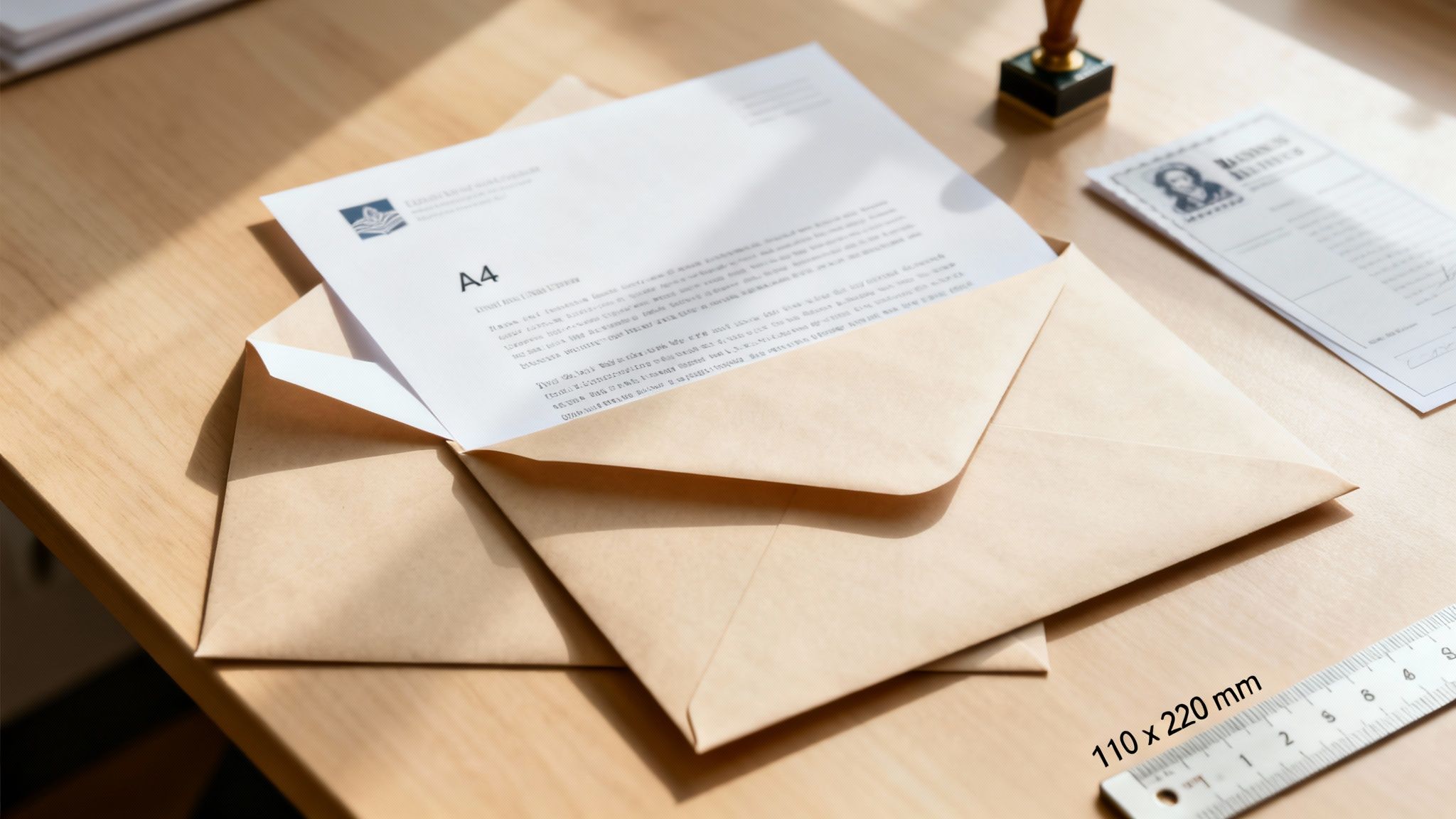
The DL envelope is a proper workhorse in UK business correspondence, but its name can be a bit of a head-scratcher. Unlike the C-series, 'DL' has nothing to do with A-series paper sizes. It simply stands for Dimension Lengthwise, which is a rather straightforward way of describing its distinct, rectangular shape.
Measuring exactly 110 x 220 mm (that's about 4.3 x 8.7 inches), the DL is perfectly sized to hold a standard A4 sheet folded neatly into thirds. This simple feature makes it the default choice for a huge range of business mail, from sending official letters and invoices to posting out marketing materials.
Its widespread use means it’s instantly recognisable and gives off a professional vibe. The neat, compact size isn't just efficient for posting; it also presents your information in a tidy, digestible way when your customer opens it.
Common Use Cases for DL Envelopes
The sheer versatility of the DL envelope means it’s used for countless jobs. Its slim profile is ideal for automated inserting machines in high-volume mail shots, but it works just as well for everyday office post. It’s this balance of efficiency and professionalism that keeps it so popular.
You’ll most often find DL envelopes used for:
- Business Letters and Official Correspondence: The go-to format for most professional communications.
- Invoices, Statements, and Reminders: The perfect size for sending financial documents.
- Promotional Flyers and Leaflets: A DL-sized flyer fits perfectly inside without any extra folding. To really make your campaign pop, check out our guide on the correct dimensions for a flyer to ensure a perfect fit.
- Direct Mail Campaigns: A cost-effective and hugely popular choice for getting marketing materials through the letterbox.
When to Choose a DL Envelope
Deciding between a DL, C5, or C6 often boils down to your content and how you want to present it. If you're sending a single A4 letter or a tri-fold leaflet, the DL is your best bet. It keeps everything snug and looks smart.
For multi-page documents or items you'd rather not fold so much, a C5 (which fits A4 folded in half) might be a better shout. But for the vast majority of day-to-day business mail, the DL envelope hits that sweet spot between practicality, cost, and a professional finish.
Getting to Grips with US Envelope Sizes
If you’re sending mail to the United States, you'll quickly realise their envelope system is a different world entirely. Forget the metric-based ISO standards we use in the UK. The US relies on a traditional, imperial-based system where sizes are designated by numbers, often with a hash symbol (like #10). It’s a completely separate standard from our C-series, so there's no easy, direct conversion.
The undisputed champion of American business mail is the #10 envelope. Measuring 4⅛ x 9½ inches (105 x 241 mm), it’s their equivalent of our DL envelope. It's designed to perfectly hold a US Letter size sheet (which is a bit shorter and wider than our A4) folded into three. This is where a common headache begins for UK businesses, as those slight paper and envelope differences can lead to some awkward folding fiascos.
Key US Business Envelope Sizes
While the #10 is the most common, there are a few other sizes you’re likely to come across. Each one has its own specific job, from reply mail to more formal letters.
Here are a few of the main players:
- #9 Envelope (3⅞ x 8⅞ inches): This one is often used as a reply envelope. Why? Because it’s designed to slip neatly inside a #10 envelope without needing to be folded.
- #6¾ Envelope (3⅝ x 6½ inches): A smaller, more compact option you’ll see used for personal letters, cheques, or short invoices.
- Monarch Envelope (3⅞ x 7½ inches): A touch more formal and elegant than a standard #10, the Monarch is typically reserved for personal stationery or executive letterheads.
So, why the different systems? It all comes down to history. The US standardised their paper and envelope sizes much earlier, with a system developed by William Irwin Martin outlined in the Stationers' Handbook of 1876. When the UK and Europe later adopted the metric C-series, it was a conscious move away from these older, imperial conventions. You can read more about this divergence in measurement standards on the UK Metric Association website.
The single most important thing for UK businesses to remember is this: a standard A4 sheet of paper (210 x 297 mm) does not fit nicely into a US #10 envelope when folded into thirds. Our A4 paper is taller, which means it will either bunch up or require an extra, clumsy-looking fold. It just looks unprofessional. If you’re mailing to the US, your best bet is to either print on US Letter paper for a perfect fit or opt for a slightly larger envelope, like a C5, to accommodate your A4 document properly.
Preparing Artwork for Custom Envelope Printing
Turning a plain envelope into a powerful piece of branding starts with getting the artwork right. To avoid common printing headaches like weird white borders or chopped-off logos, it’s essential to understand a few key terms from the print world: bleed, trim, and the safe margin.
Bleed is the part of your design that stretches beyond the final cut edge of the envelope. Think of it as a safety net. The trim is the actual line where we'll cut the envelope to its finished size. And finally, the safe margin is the inner border where you should keep all your important bits – like text and logos – to make sure they don’t get clipped during the production process.
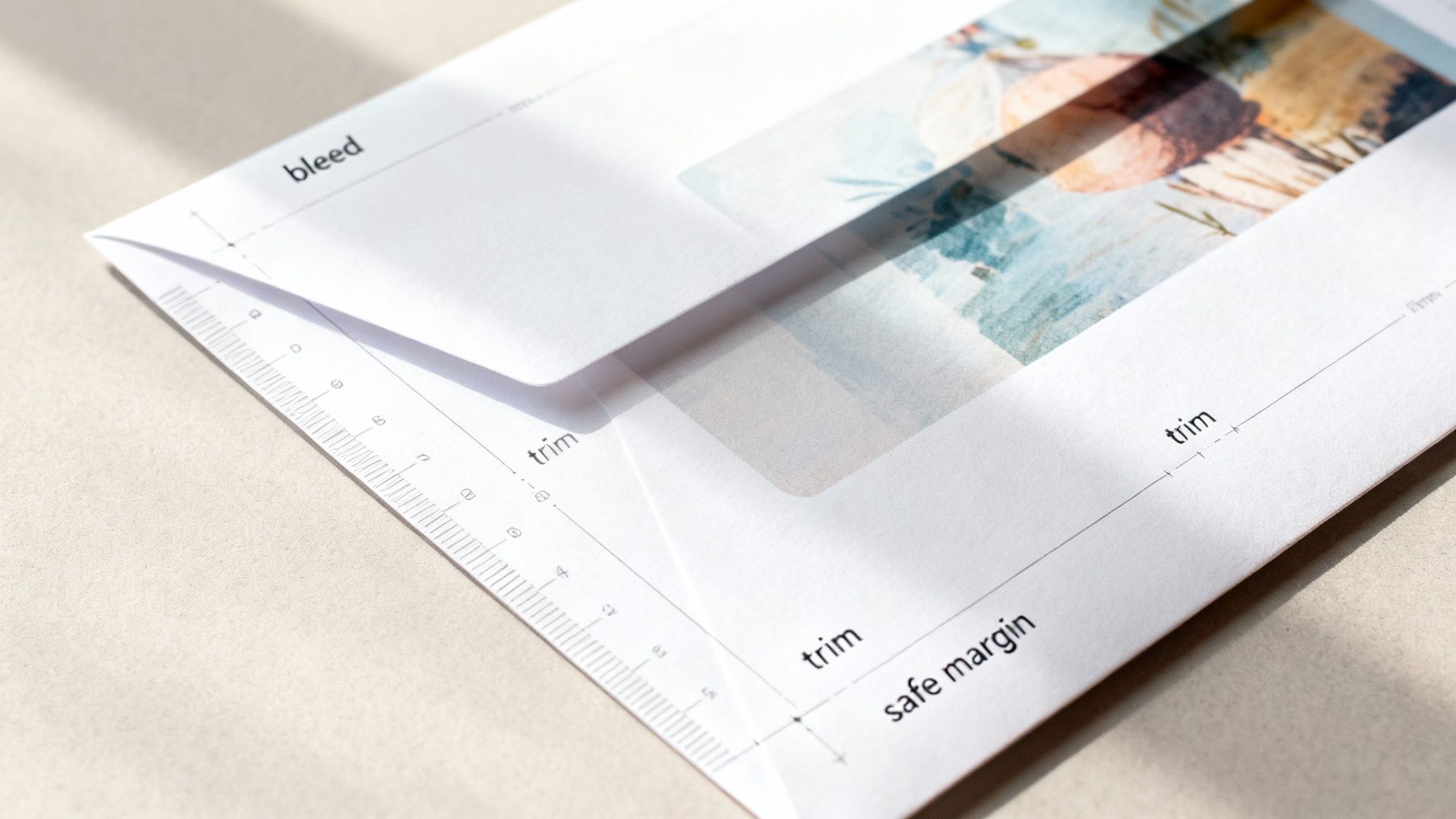
Key Artwork Specifications
To get that sharp, professional finish you're after, your digital files need to meet a few technical standards. Submitting artwork that isn't quite right can cause delays and lead to a final product that doesn't look as good as you'd hoped. Nailing these things from the start makes everything run smoothly.
For instance, a logo with a low resolution will look fuzzy and pixelated when printed. Using the wrong colour mode is another classic pitfall – it can make your brand colours look dull or just plain wrong compared to how they looked on your screen.
Crucial Tip: Always set up your design file in CMYK (Cyan, Magenta, Yellow, Key/Black) from the very beginning. This is the four-colour standard for professional printing, ensuring the colours you chose are the colours that get printed. RGB is designed for screens and will definitely cause colour shifts in print.
To make this crystal clear, here’s a quick-glance table of our essential artwork requirements. Following these specs ensures a top-quality print every time.
| Specification | Recommendation | Reason |
|---|---|---|
| Bleed | Minimum of 3mm on all sides | Prevents white edges appearing after trimming, as the print machinery has a small margin of error. |
| Safe Margin | At least 5mm from the trim edge | Protects your important text and logos from being accidentally cut off during the finishing process. |
| Resolution | Minimum 300dpi (dots per inch) | Ensures all images and graphics are sharp, crisp, and professional-looking, not blurry or pixelated. |
| File Formats | PDF or AI (Adobe Illustrator) | These vector-based formats maintain quality at any size and are the industry standard for print. |
Getting these technical details right is just as crucial as the design itself. A beautiful design can be let down by a poorly prepared file.
File Format and Font Guidelines
For the best results, we always recommend submitting your files in a vector-based format like PDF or AI. This type of file can be resized without losing a single bit of quality. To make sure your designs translate perfectly onto our custom envelopes, it's always a good idea to check out some general artwork submission tips before you send your files over.
Here’s a quick recap of the core requirements for print-ready artwork:
- Bleed: A non-negotiable 3mm on every side.
- Resolution: All images must be at least 300dpi.
- File Formats: We love PDF or AI files the most.
- Fonts: Make sure all your text is converted to outlines (or curves). This locks the font in place and stops any weird font-swapping issues on our end.
Sticking to these guidelines means that no matter which standard envelope dimensions you pick, your design will be printed accurately and look fantastic. For an even deeper dive, we have more info in our guide on printing onto envelopes.
UK Postage and Mailing Guidelines
Choosing the right envelope is only half the battle. You’ve also got to get the postage right, or you could find yourself facing unexpected charges and frustrating delays. In the UK, Royal Mail sets the rules, and understanding their size and weight categories is crucial for your budget and delivery success.
The two main categories you absolutely need to know are Letter and Large Letter. To qualify for a specific price band, your mailshot has to fit neatly within the maximum dimensions for that category. A standard DL or C6 envelope, for instance, will nearly always slide into the 'Letter' category, as long as it isn't overstuffed or too heavy.
Things change when you move up to a C5 or C4 envelope. Because of their larger face dimensions, these are almost always classed as a 'Large Letter'. This little detail is a game-changer when you're budgeting for a direct mail campaign – the price difference between the two can really stack up across hundreds or thousands of items.
How Envelope Size Affects Postage Costs
Royal Mail’s entire pricing system is built around very specific thresholds for size and weight. If you go over any single one of them—length, width, thickness, or weight—your item gets bumped into the next, more expensive category. Simple as that.
Here are the key numbers to keep in your head:
- Letter: Must be under 100g, with max dimensions of 240mm x 165mm and a max thickness of 5mm.
- Large Letter: Can go up to 750g, with max dimensions of 353mm x 250mm and a max thickness of 25mm.
This means the total weight of your envelope and everything inside it is just as important as its physical size. For example, using a heavyweight paper stock for an A4 letter could tip the scales over the 100g limit for a standard Letter, even when neatly folded into a DL envelope. The result? Higher postage costs you might not have planned for.
Addressing and Weight Considerations
Getting the address right ensures your mail sails through Royal Mail’s automated sorting machines without a hitch. The recipient's address should be on the front, towards the bottom-left, with the stamp firmly in the top-right corner. It’s also good practice to put your return address on the back flap.
Interestingly, while we’re all used to grams now, weight calculations were once based on imperial units. It was on 29 September 1975 that the UK Post Office officially completed its full switch to metric measurements, standardising postal tariffs from ounces to grams. You can read more about this important metrication timeline. That move cemented the gram-based system we rely on today, making an accurate set of scales an essential tool for any business that sends mail.
Choosing Your Perfect Custom Envelopes
Once you've got your head around the standard envelope sizes, the fun part begins: creating branded mail that actually feels like your business. Moving away from plain, off-the-shelf options is your chance to make a brilliant first impression before your letter is even opened. It all comes down to picking the right materials, finalising your design, and working with a printer who gets what you're trying to do.
First up, let's talk paper. The stock you choose says a lot. A heavier, textured paper can give a sense of quality and importance, while a smooth, recycled stock shows you’re thinking about sustainability. Here at The Print Warehouse, we offer a whole range of finishes and eco-friendly options to match your company’s values perfectly.
Next, you'll need to decide between windowed or non-windowed. Windowed envelopes are a no-brainer for invoices and official letters – they save a ton of time and cut down on addressing mistakes. For marketing pieces or invitations, a non-windowed envelope gives you a full, uninterrupted canvas to get creative with your design.
From Artwork to Production
Bringing your vision to life is a straightforward process. Once your design is ready, you can upload your artwork directly to our platform. We’ll then ping you a digital proof to approve, which shows you exactly how the finished product will look. This little step ensures everything is spot-on before we hit the print button.
As a UK-based printer, we handle every stage of production right here, in-house. This gives us complete control over quality and means we can offer much faster turnaround times, getting your custom envelopes delivered quickly and reliably.
Ordering and Support
We’ve made ordering simple, whether you need a small batch for a special event or a massive run for a big mailout. For businesses with serious mailing needs, we offer bulk order discounts to provide even better value. Our friendly support team is always on hand to answer questions or offer a bit of advice on your project.
Ready to create your ideal mailers? You can explore our full range and get your order started by browsing our selection of high-quality, customisable envelopes today.
Got a Question About Envelope Sizes?
When you’re planning a mailshot or getting some documents printed, the world of standard envelope dimensions can throw up a few questions. Getting the right answers quickly can be the difference between a smooth project and a frustrating one. Here are some of the most common queries we get from customers.
Common UK Envelope Queries
One of the first things people want to know is which envelope is the standard for business use here in the UK. That’s an easy one: the DL size (110 x 220 mm) is far and away the most popular choice for any professional correspondence. It’s perfectly proportioned to hold a sheet of A4 folded into thirds, making it the go-to for everything from invoices to formal letters.
Postage costs are another hot topic. A couple of questions we often hear are:
- Can I just use a standard stamp for a C5 envelope? Yes, you certainly can. As long as the total weight is under 100g and the envelope is less than 5mm thick, it qualifies as a standard 'Letter' with Royal Mail.
- Are square envelopes more expensive to post? Not necessarily. In the UK, Royal Mail bases its pricing on size and weight categories. Provided a square envelope fits within the 'Letter' or 'Large Letter' specifications, it’ll cost exactly the same to post as a rectangular one in the same band.
Making Sense of Paper and Envelope Sizes
Understanding how paper and envelope sizes relate to each other is a game-changer. We’re often asked about the difference between A4 and C4, and it’s simpler than you might think. A4 (210 x 297 mm) is a standard paper size, while C4 (229 x 324 mm) is the envelope designed to hold it.
A C4 envelope is perfectly sized to fit an A4 sheet completely unfolded, which is ideal for sending important documents like certificates or contracts that you really don’t want to crease. This simple but brilliant relationship is the whole basis of the ISO sizing system.
At The Print Warehouse Ltd, we offer a huge range of custom-printed envelopes in all the standard UK sizes, helping to make sure your mailings always look professional. Take a look at our options and upload your design today.
Share with Friends & Family:
Related Blogs:
Featured Products: