Cheap Booklet Printing UK Your Guide to Quality on a Budget
Published on
When people hear the term cheap booklet printing in the UK, they often think it means compromising on quality. That couldn’t be further from the truth. Getting professional results on a tight budget isn't about cutting corners; it’s about making smart, informed decisions.
The secret is knowing how simple choices like the paper you pick, the binding you use, and the size of your print run can dramatically lower your costs without sacrificing that all-important professional finish.
Getting Professional Booklets on a Small Budget
Forget the generic advice you’ve read elsewhere. This guide is a clear roadmap designed specifically for UK businesses and creators who want stunning booklets that won’t break the bank.
Thanks to modern digital printing, cost-effective short runs are more accessible than ever, opening the door for anyone to produce high-quality materials. We'll walk through real-world strategies to help you navigate the options and steer clear of the common pitfalls that secretly inflate costs. By focusing on a few key specifications, you can achieve a premium feel while keeping your expenses firmly in check.
Understanding the Modern Print Market
The UK printing industry is a surprisingly resilient and massive market. Despite facing its share of challenges, it still holds a market size of £9.2 billion, with profit margins expected to climb to 5.5% by 2025.
A big part of this resilience comes from printers specialising in niches like short-run digital printing which is fantastic news for anyone needing affordable booklets. Small businesses and independent creators are increasingly using digital presses, which can slash setup costs by up to 70% compared to old-school offset printing. This shift makes it completely viable to order as few as 50 copies, a real game-changer for smaller projects.
Key Takeaway: The rise of efficient digital printing means that "cheap booklet printing" now offers higher quality and more flexibility than ever before. You no longer need to order thousands of copies to get a professional, affordable result.
Integrating Booklets into Your Strategy
To get the most out of your print budget, your booklet needs to be part of a bigger plan. Think of it as a tangible piece of your brand, crafted to inform, persuade, or engage your audience.
Whether you're creating a product catalogue, an event programme, or an informational guide, its success hinges on how well it aligns with your overall goals. If you're building out your plan, exploring different small business marketing strategies can provide some brilliant context.
From the initial design to the final distribution, every decision should support your business objectives. This ensures your investment delivers a strong return. You can explore a variety of booklets and brochures to get a feel for how different specifications can work for your campaign.
Making Smart Choices That Lower Your Printing Costs
The biggest impact on your final printing bill comes down to a few key decisions you make long before you click "order". When you're looking for cheap booklet printing in the UK, understanding how your specifications affect the price is the most powerful tool you have. Let's get practical and break down the choices that will save you the most money.
These choices really boil down to a few core elements that printers use to calculate your quote. The infographic below highlights the three biggest factors that will influence your final cost.
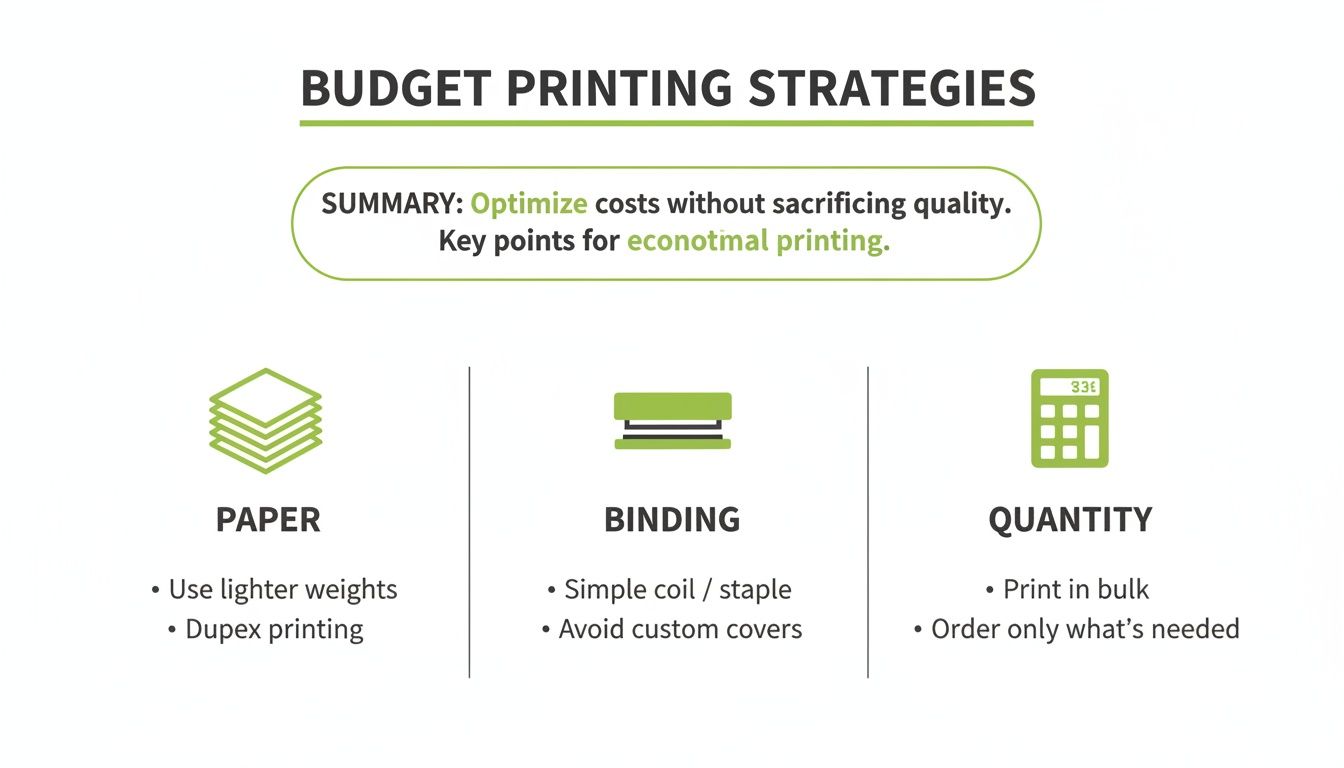
As you can see, getting a handle on your paper, binding, and quantity choices is the most direct path to a more affordable print run, all without having to sacrifice a professional finish.
To help you visualise this, here's a quick comparison of how different choices can add up.
How Your Booklet Specification Choices Impact Cost
| Specification | Low-Cost Option | Higher-Cost Option | Cost Impact Notes |
|---|---|---|---|
| Size | A5 (148 x 210 mm) | Custom Size (e.g., 200 x 200 mm) | Standard sizes mean less paper waste, directly lowering your cost. |
| Paper Weight (Cover) | 170gsm Silk | 300gsm Silk or Laminated | A heavier, thicker cover feels premium but adds a noticeable cost. |
| Paper Weight (Inner) | 130gsm Silk | 170gsm Silk or Uncoated | 130gsm is the industry standard for a reason—it's cost-effective and looks great. |
| Binding | Saddle-Stitched | Perfect Bound | Saddle-stitching is fast, automated, and the most budget-friendly binding method. |
| Lamination | None | Matt or Gloss Lamination | Lamination adds a protective and tactile layer but increases the price per booklet. |
This table gives you a clear idea of where you can make easy savings. Stick to the "Low-Cost Option" column, and you're already well on your way to a budget-friendly print job.
Select Standard Sizes to Minimise Waste
The first and easiest way to slash costs is by choosing a standard paper size. A5 (148 x 210 mm) is by far the most popular and cost-effective option for booklets, with A6 (105 x 148 mm) not far behind.
Here’s why it matters: printers buy paper in massive parent sheets. Standard sizes like A5 and A6 are designed to be cut from these sheets with almost zero waste. If you request a custom size, say 200mm x 200mm, the printer still has to use the same large sheet, but the offcuts can't be reused for another job. You essentially end up paying for that wasted paper.
Pro Tip: Unless a custom dimension is absolutely essential for your design, just stick with A5. It offers a great balance of reading space and cost-efficiency, making it a reliable choice for everything from event programmes to marketing brochures.
Choose Lighter Paper Weights
Paper is measured in grams per square metre (gsm). A higher gsm number means heavier, thicker paper, which feels more premium but also costs more. A simple way to save is by selecting a slightly lighter paper stock, especially for the inner pages.
Here are a few common paper types and weights to consider:
- 130gsm Silk or Gloss: An excellent, budget-friendly choice for inner pages. It has a quality feel without the expense of heavier stocks and is perfect for both text and images.
- 170gsm Silk or Gloss: This offers a bit more substance and is often used for covers or higher-end booklets. It provides a noticeable step up in quality.
- Uncoated Paper: This has a more natural, matte finish. While it can look very stylish, it often costs slightly more than a standard silk or gloss paper of the same weight.
For most projects, a 170gsm silk cover with 130gsm silk inner pages is the perfect combination for cheap booklet printing in the UK. This pairing feels professional to the touch while keeping your costs firmly in check.
Embrace Saddle-Stitching for Binding
The way your booklet is held together also has a significant impact on price. For the vast majority of projects, the choice is clear.
Saddle-stitching is simply the process of folding sheets and stapling them along the spine. It is by far the most economical binding method for booklets with a lower page count (typically up to 48-64 pages). The process is fast, automated, and uses minimal materials, which translates directly into savings for you. It's the standard for magazines, programmes, and most marketing brochures. You can explore the benefits and options for cost-effective saddle-stitched booklets to see if it’s the right fit.
In contrast, perfect binding involves glueing the pages to a squared-off spine, like a traditional paperback book. It looks very polished, but it's a more complex and expensive process. It’s best reserved for thick documents or premium publications where the budget is larger.
Choosing the Right Print Run for Your Budget
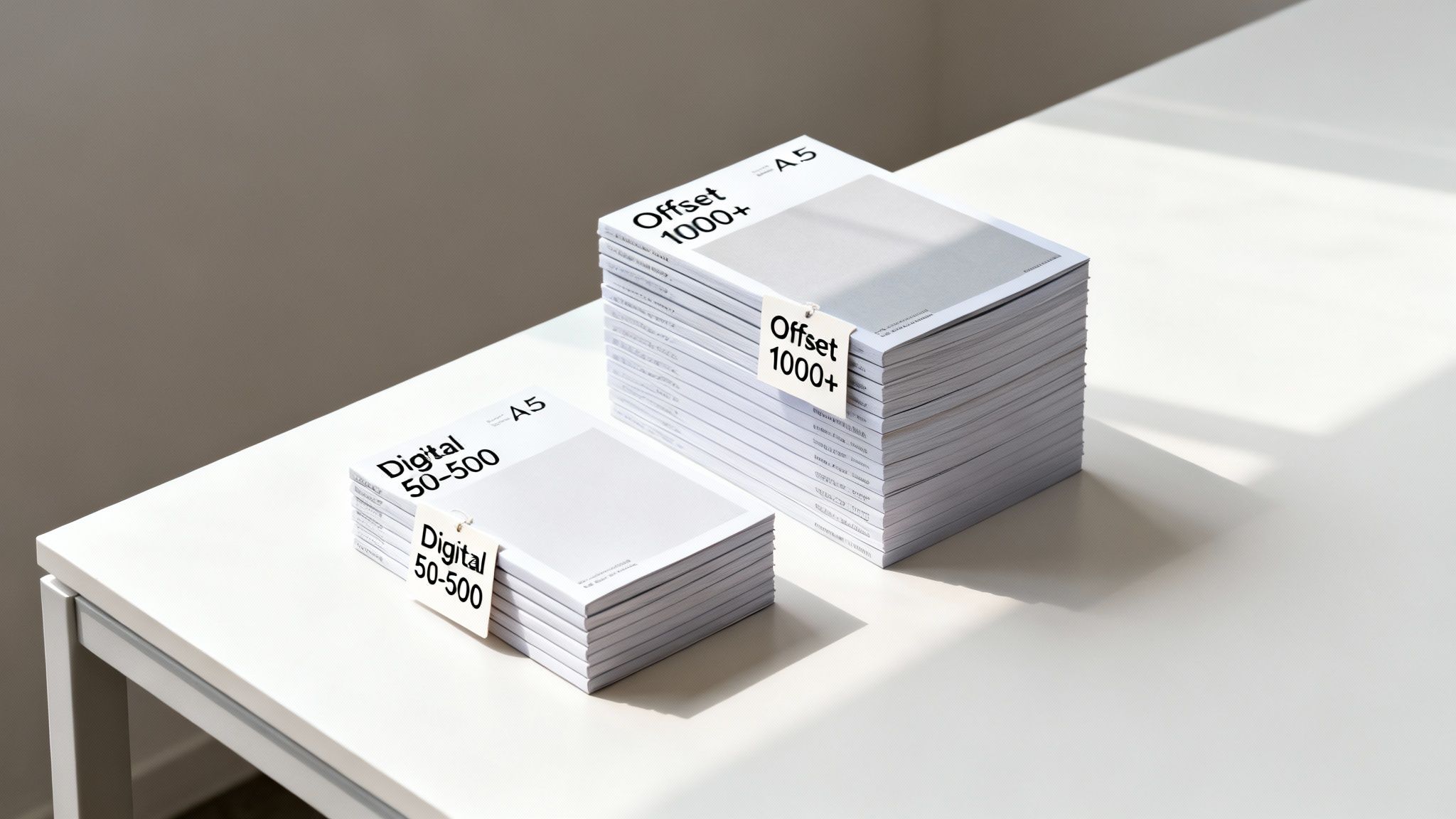
Getting a great deal on your booklets often comes down to one thing: quantity. The number you order is a huge factor in the final price, and it all boils down to the technology used to bring them to life. The two main methods are digital and offset printing, and knowing the difference is key.
For smaller, more targeted projects, digital printing is almost always your best bet. Think of it as a super-powered office printer. There are practically no setup costs involved, which makes it perfect for short runs—typically anywhere from 50 to 500 copies. It’s flexible, fast, and cost-effective for smaller jobs.
This approach is brilliant when you don't want a mountain of stock gathering dust. A local café printing a seasonal menu, for instance, only needs enough copies for a couple of months. Or maybe a startup just needs 100 brochures for its very first trade show. Digital printing makes these small runs financially sensible.
Digital vs Offset Printing
On the other end of the spectrum is offset printing, the traditional workhorse for massive print jobs. This method is a bit more old-school, involving custom metal plates and a more complex setup process. While that initial investment is higher, the cost-per-booklet drops dramatically once you start ordering in bulk think quantities of 1,000 or more.
So, which one should you go for? The answer really depends on what you need.
- Choose Digital Printing if:
- You need fewer than 500 booklets.
- You're on a tight deadline and need a quick turnaround.
- You think you might need to make small tweaks for a future reprint.
- Choose Offset Printing if:
- You're ordering well over 1,000 booklets.
- Your timeline is flexible, as the setup takes a bit longer.
- You’re printing something that won't change, like a finished novel or an annual report.
For most small and medium-sized UK businesses, digital printing hits that sweet spot of quality, speed, and affordability. The big savings from offset printing only really kick in at volumes that are often far more than what’s needed for day-to-day marketing.
The Rise of Print on Demand
Another fantastic option for anyone watching their budget is the boom in the UK's print-on-demand (POD) market. It was valued at $508 million in 2023 and is expected to rocket to an incredible $2.4 billion by 2030. This growth is all down to online platforms that let you upload a design and get just a handful of copies printed, without the huge minimum orders of the past.
This model is a real game-changer. It lets you print tiny batches sometimes just 1 to 100 copies without any setup fees eating into your budget. For businesses and creators, this means you can test a new design, create a proof-of-concept, or produce materials for a very small event without a big upfront investment. It’s the ultimate way to manage cash flow while still getting professional results.
While POD is brilliant for those ultra-low quantities, if you’re looking for a slightly larger run with thicker paper or a more premium finish, exploring options like our high-quality perfect bound booklets can give you a more polished and durable result.
Preparing Your Artwork to Avoid Costly Mistakes
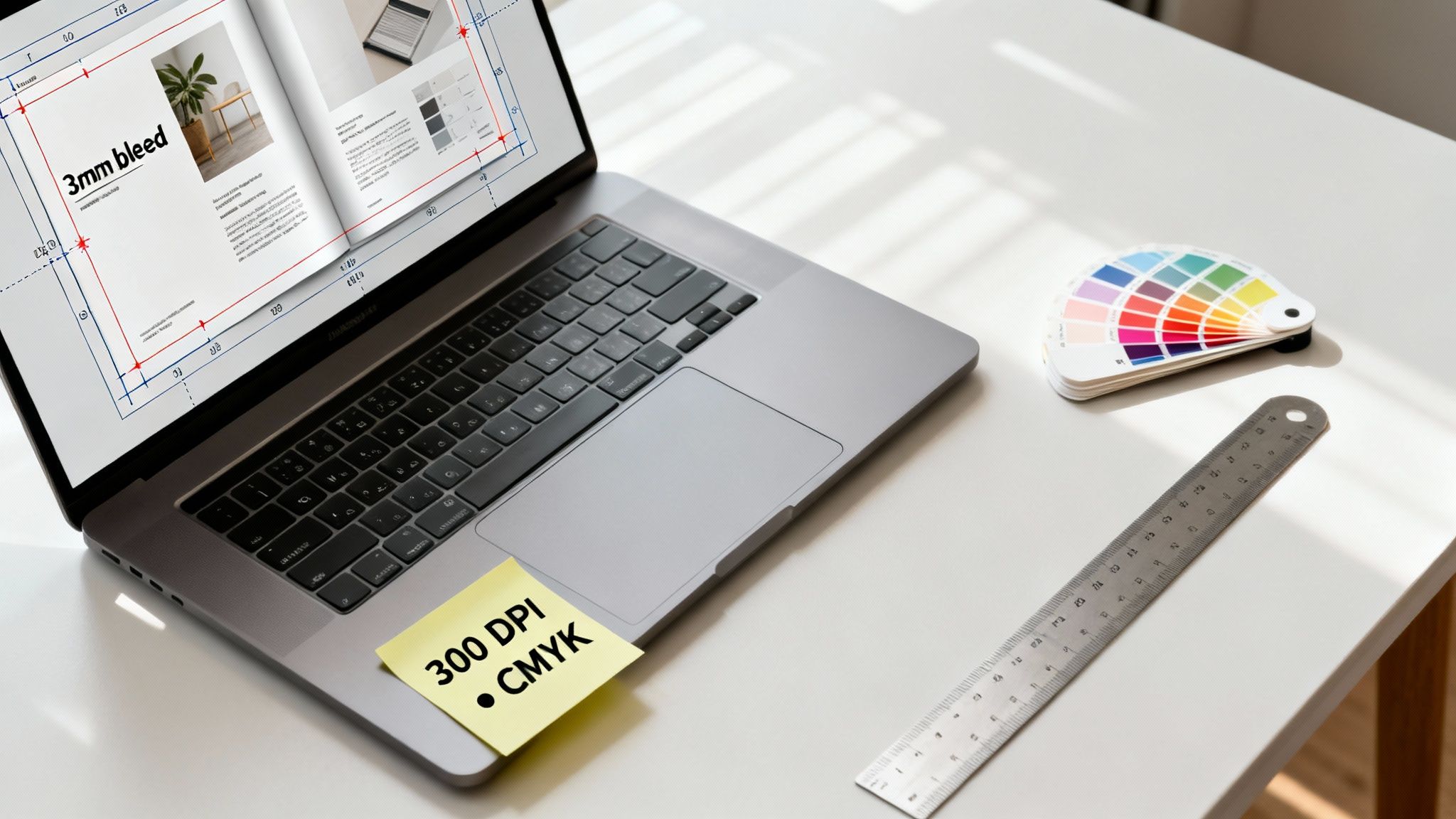
One of the biggest hidden expenses in booklet printing isn’t the paper or the binding it’s a poorly prepared artwork file. Getting your design print-ready isn't just a technical step; it's your best defence against costly reprints, frustrating delays, and a final product that just doesn't look right.
Think of it as your pre-flight checklist. Taking a few moments to ensure your files are correct can save you a world of pain and make your journey to affordable booklet printing in the UK a much smoother one.
The Three Pillars of Print-Ready Design
Before you even think about uploading your files, there are three non-negotiable technical requirements every professional UK printer will expect. Get these right from the start, and you’ll sidestep the vast majority of common print errors.
-
Set a 3mm Bleed: Bleed is a small margin of your background colour or image that extends beyond the final trim edge of your page. When the print machinery cuts your booklets to size, this tiny 3mm buffer ensures you won't get any unsightly white slivers along the edges. It’s a small detail that makes a huge difference.
-
Use High-Resolution Images: For print, all your images and graphics must have a resolution of 300 DPI (dots per inch). Anything lower, like the 72 DPI standard for web images, will look blurry and pixelated on the page. There’s no fixing this after the fact, so check your image quality first.
-
Convert Colours to CMYK: Your screen displays colours in RGB (Red, Green, Blue), but professional printers use CMYK (Cyan, Magenta, Yellow, Black). Converting your artwork to CMYK mode in your design software gives you a much more accurate preview of how the colours will actually look when printed.
Understanding the Safe Zone
Beyond the technical setup, you need to be mindful of where your content sits on the page. The safe zone (or safe margin) is an area just inside the trim line, typically another 3-5mm from the edge.
It's crucial to keep all your important text, logos, and key design elements within this zone. This guarantees that nothing gets accidentally chopped off during the final cutting process. Placing text too close to the edge is a classic mistake that can ruin an otherwise perfect booklet.
Expert Tip: Most online printers offer free downloadable templates for their products. Using these templates is the easiest way to ensure your bleed, trim, and safe zone are all set up correctly before you even begin designing.
The Proofing Process Demystified
Once you upload your artwork, you'll be asked to approve a proof. This is your final chance to catch any mistakes before hundreds of copies are printed. Don't skip it!
Most companies offering cheap booklet printing in the UK provide a free digital PDF proof. This is perfect for double-checking spelling, grammar, layout, and image placement. For the vast majority of projects, a careful review of this PDF is all you’ll need.
However, if your project relies on perfect colour matching for a specific brand, you might consider a paid physical proof. This is a single printed copy of your booklet, showing you exactly how the colours will appear on your chosen paper stock. It costs a bit more and adds time to the schedule, but for colour-critical work, it provides invaluable peace of mind.
To stretch your budget further, you could look into ways to create a professional book cover for free using some of the great online resources available. This frees up more of your budget for the physical printing itself.
Finding Hidden Savings in the Ordering Process
Alright, you’ve got your artwork sorted. Now comes the part where a bit of savvy can make a real difference to your final bill: the online ordering process. This is where you can turn a standard purchase into a masterclass in getting cheap booklet printing in the UK. The trick is to look past the first price you see and spot the hidden wins.
First things first, always look for printers who offer a free file check service. This is an absolute lifesaver. Whether it's an automated system or a real person having a quick look, it can catch technical gremlins like incorrect bleed settings or low-res images before they hit the press. Catching a simple mistake here saves you the costly headache of a botched print run and an inevitable reprint.
Plan Your Delivery for Maximum Savings
One of the easiest ways to slash costs is simply by not being in a rush. Express or next-day delivery options always come with a premium price tag that can seriously inflate your total spend. Unless you’re up against a genuinely tight deadline, always go for the standard delivery option.
If you can plan your project just a week or two in advance, you’ll unlock the most economical shipping options. For instance, choosing a 5-day turnaround instead of a 24-hour one can often knock 10-15% off the final cost. That simple bit of forward-thinking is pure profit back in your pocket.
Hunt for Discounts and Promotions
Never, ever click "confirm order" without a quick hunt for extra savings. Most UK online printers use discount codes to bring in new customers and keep loyal ones happy. Here are a few quick wins to try:
- Newsletter Sign-Ups: Scroll to the bottom of the printer’s website. You’ll often find a newsletter subscription box offering a sweet deal, like 10% off your first order, just for signing up.
- Discount Codes: Before you pay, open a new tab and search for "[Printer Name] discount code". It takes 30 seconds, and you might stumble upon a seasonal promotion or a partnership deal.
- Compare Quotes: Don't just settle for the first price you get. Spend five minutes getting instant quotes from two or three different printers. Prices can vary more than you’d think, and this tiny bit of effort ensures you’re getting the best rate on the market.
Key Insight: Remember, the cheapest price isn't everything. When you're comparing printers, also check their review scores, see how helpful their customer support seems, and confirm they offer those all-important free file checks. The cheapest quote isn't good value if it comes with risks.
And while you're focused on booklets, it's worth a quick sanity check. If your content is quite concise, a simpler format might be more effective and cheaper. It’s worth reading our guide on how to decide between flyers or leaflets to see if a different format could be a better fit for your budget.
Answering Your Final Booklet Printing Questions
Even after you’ve worked through all the options, a few last-minute questions can crop up just before you hit that ‘order’ button. It’s completely normal. When you’re hunting for cheap booklet printing in the UK, getting those final queries sorted gives you the confidence to move forward.
Let’s tackle some of the most common ones we hear.
What Is the Cheapest Way to Bind a Booklet?
For booklets under around 48-64 pages, saddle-stitching is almost always the most budget-friendly choice. It’s the classic binding you see on magazines and event programmes, where folded sheets are simply stapled along the spine.
The process is fast, heavily automated, and uses very little material. That efficiency translates directly into savings, making it the industry standard for brochures, newsletters, and catalogues where keeping costs down is a priority.
Does Using More Colours Increase the Price?
This is a common worry, but the good news is: not anymore. With modern digital printing (which is what we use for most short-run booklet orders), the price is exactly the same whether your design is in full colour or simple black-and-white.
Digital presses run on a CMYK (Cyan, Magenta, Yellow, and Black) system by default. That means you can go wild with vibrant, eye-catching colours throughout your design without it costing you a penny more. The only time you might see a tiny cost difference is on massive, traditional offset print runs, but for most UK businesses, this isn't a factor.
How Can I Ensure My Printed Colours Look Accurate?
To get the colours you see on your screen to match the final print, always design and save your artwork in CMYK colour mode. Don't use RGB, as that’s designed purely for screens and can lead to disappointing results on paper.
Every UK online printer should offer a free digital PDF proof. This is brilliant for a final check of your spelling, grammar, and layout before it goes to press.
If your project depends on hitting a very specific brand colour—like a particular shade of navy for a logo—it’s worth ordering a physical 'hard copy' proof. It adds a small cost, but it lets you see exactly how the colours will look on your chosen paper, giving you complete peace of mind.
Is It Cheaper to Print More Booklets at Once?
Yes, absolutely. The price per booklet drops significantly as your order quantity goes up. This is all down to what’s known as economy of scale.
Think of it this way: the initial setup costs getting the files ready, calibrating the machines are the same whether you’re printing 50 booklets or 500. When you order a larger batch, that fixed cost gets spread thinly across more items, making each individual booklet much cheaper. It’s always worth playing with the quantities on an online quote tool to find the most cost-effective number for your needs.
If you’re keen to dive deeper into print specifications and design tips, you’ll find tons of useful advice by exploring the world of professional printing on our blog.
Ready to bring your project to life with high-quality, affordable printing? At The Print Warehouse Ltd, we make it simple to get professional results without breaking the bank. Get an instant quote and order your custom booklets today at https://theprintwarehouse.uk.
Share with Friends & Family:
Related Blogs:
Featured Products: