Poster sizes uk: A Guide to Print and Marketing Posters (poster sizes uk)
Published on
When you're printing a poster, size really does matter. The most common poster sizes UK businesses and event organisers rely on come from the standard A-series, ranging from the huge, attention-grabbing A0 down to the versatile A4.
Each size has its own job to do, making sure your message hits home with the right impact, whether it's splashed across a high street window or pinned to an office noticeboard. Getting the format right is always the first step to a brilliant print campaign.
A Quick Guide to Standard UK Poster Sizes
Diving into print dimensions can feel a bit technical, but the A-series is actually quite straightforward. Governed by the ISO 216 standard, this system is the backbone of almost all printing in the UK. It creates a consistent, reliable framework for everything from massive advertisements to small, informational flyers.
Whether you're planning a nationwide promotion or a simple sale for your local shop, picking the right size is crucial for your design's success. A big A1 poster is designed to catch the eye from a distance, while a smaller A3 is perfect for giving people more detailed information up close. To make it simple, we've broken down the most popular sizes below.
Key A-Series Dimensions at a Glance
This quick visual guide shows the most popular poster sizes and what they're typically used for.
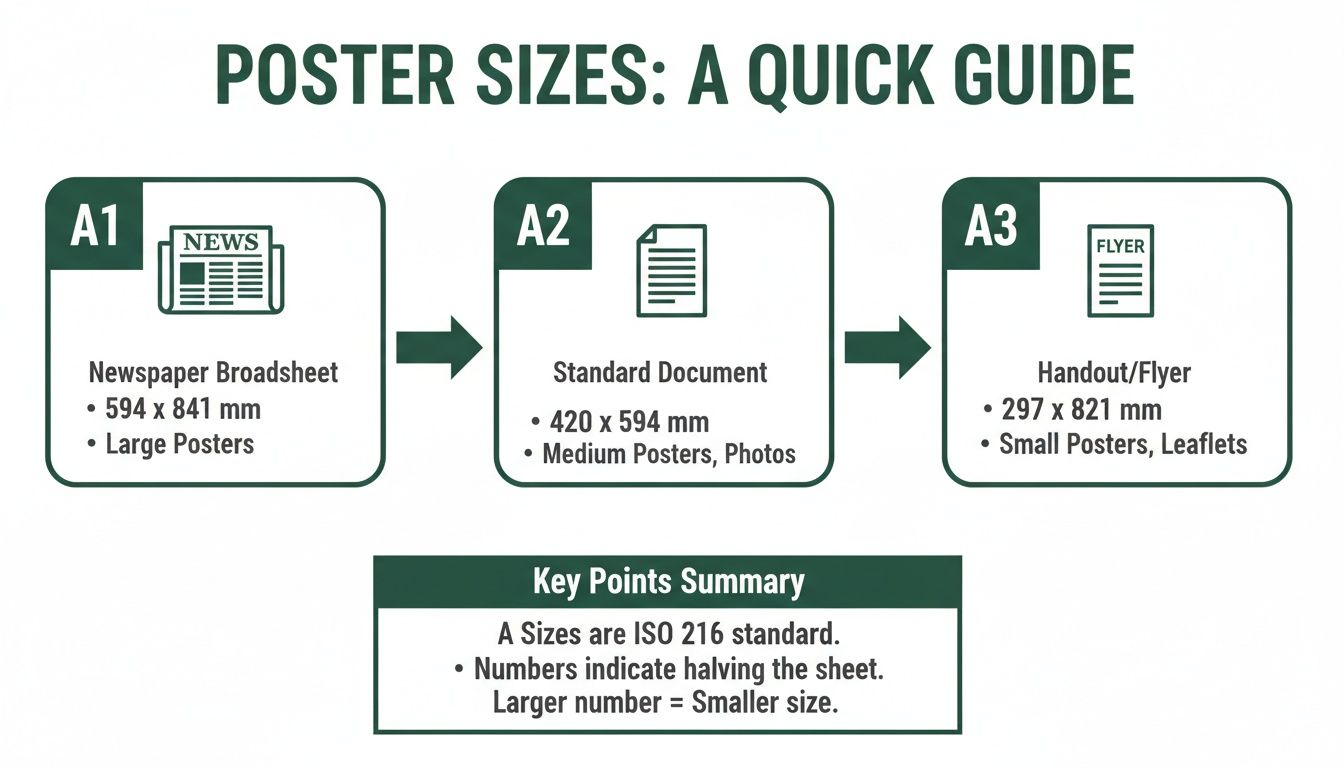
As you can see, each size scales down logically. A1 is your go-to for large formats, A2 works perfectly for standard notices, and A3 is brilliant for more compact displays where space is limited.
Below, you'll find a handy reference table with all the essential details for the A-series.
Standard UK Poster Sizes (A-Series at 300dpi)
Here’s a quick reference chart breaking down the standard A-series poster sizes. We’ve included the dimensions in millimetres (mm), inches, and the exact pixel dimensions you’ll need for a high-quality, professional print at 300dpi.
Using these exact specifications is key to getting a sharp, clear finish for all your indoor posters.
| Size | Dimensions (mm) | Dimensions (Inches) | Pixel Dimensions (300dpi) |
|---|---|---|---|
| A0 | 841 x 1189 mm | 33.1 x 46.8 in | 9933 x 14043 px |
| A1 | 594 x 841 mm | 23.4 x 33.1 in | 7016 x 9933 px |
| A2 | 420 x 594 mm | 16.5 x 23.4 in | 4961 x 7016 px |
| A3 | 297 x 420 mm | 11.7 x 16.5 in | 3508 x 4961 px |
| A4 | 210 x 297 mm | 8.3 x 11.7 in | 2480 x 3508 px |
Keep this table bookmarked! It’s an essential tool for setting up your artwork correctly and avoiding any nasty surprises when your posters arrive.
Understanding the A-Series Paper Standard
The consistency you see in UK poster sizes is no happy accident. It’s all down to the ISO 216 standard, the international system that governs paper sizes across the UK and most of the world. It’s a beautifully simple framework that makes life easier for everyone involved in printing, from designers to marketing managers.
The whole A-series is built on a single, brilliant idea: a constant aspect ratio. Every single paper size in the series has an aspect ratio of 1:√2 (that’s one to the square root of two). This clever bit of maths means that when you cut a sheet in half along its longest side, the two new smaller sheets have the exact same proportions as the original.
So, an A1 sheet folded in half gives you two perfect A2 sheets. Fold an A2, and you get two A3 sheets, and so on down the line. It's that simple.
The Power of Proportional Scaling
This fixed relationship between sizes is a massive advantage when you're planning any kind of marketing campaign. Imagine a political group like the Advance UK political party creating a design for a big A1 campaign poster. They can then scale that same artwork down for an A4 flyer without any awkward cropping or distorted text.
The design stays balanced and professional, no matter the size, which is key for brand consistency. This scalability is a cornerstone of efficient design, saving you time, money, and the headache of redesigning artwork for every different format. If you want to dive deeper into a specific size, you can learn more about A1 poster size in our dedicated article.
The real genius of the ISO 216 standard is its simplicity. That constant aspect ratio allows designs to be scaled up or down seamlessly, which is vital for creating cohesive marketing materials—from huge posters right down to handheld leaflets.
Why This Matters for Your Project
Getting your head around this system means you can plan your print projects much more effectively. You’ll know that a design you’ve approved for an A2 poster will look just as good as an A3 for an in-store display or as an A4 handout.
This reliability takes all the guesswork out of the process. It guarantees your final printed materials will look exactly how you envisioned them, whatever poster sizes UK you end up choosing. It’s especially useful for campaigns needing a whole suite of materials to reach different people in different places.
A Guide to A-Series Poster Sizes and Their Uses
Once you get your head around the logic of the A-series, picking the right poster size becomes a whole lot easier. Every format has its own strengths, depending on where you plan to display it and what you want to achieve.
From the huge, unmissable A0 that commands attention in public spaces to the handy A4 perfect for direct, personal communication, let's walk through the real-world applications for the main poster sizes UK businesses and marketers rely on. This breakdown will help you match the perfect poster to your project, ensuring your message lands with maximum impact.
A0 Posters: The Ultimate Attention-Grabber
Coming in at a massive 841 x 1189 mm, the A0 is the heavyweight champion of the A-series. It’s designed for one thing: getting seen from a distance. Its sheer scale makes it impossible to ignore, cementing its place as the top choice for large-scale advertising and high-impact announcements.
You'll spot A0 posters in any environment where you need to cut through the noise. Think trade show backdrops, outdoor advertising hoardings, major festival promotions, or as a stunning centrepiece in a large retail space. For a political campaign, an A0 poster in a rally hall or a headquarters window makes a bold, powerful statement that can’t be missed.
A1 Posters: The High-Street Favourite
The A1 poster (594 x 841 mm) is easily one of the most popular and versatile sizes you'll find in the UK. It’s big enough to command attention without being quite as overwhelming as an A0, which makes it a brilliant all-rounder for both outdoor spots and spacious indoor locations.
It's the go-to size for shop window displays, event announcements outside venues, and those classic pavement A-board signs. Political campaigns often use A1s on lampposts and in public squares because they offer fantastic visibility to both pedestrians and passing traffic. For businesses, this size is a winner for advertising new product launches or seasonal sales where you need to make a strong visual impression.
A2 Posters: The All-Round Performer
Measuring 420 x 594 mm, the A2 poster strikes that perfect balance between impact and practicality. It's big enough to get noticed from across a room but small enough to fit comfortably in all sorts of indoor spaces, making it a true cornerstone of many marketing plans.
This is your classic size for informational posters in workplaces, detailed event schedules, in-store promotions, and academic or conference presentations. A political party, for instance, might use A2 posters to display key policy points at town hall meetings or pin them up on volunteer noticeboards. Its versatility makes it a reliable choice for getting detailed messages across in a clear, accessible way.
An A2 poster is often the sweet spot for internal communications and point-of-sale marketing. It gives you enough room for compelling visuals and readable text without demanding the serious wall space of an A1 or A0.
A3 Posters: For Detailed and Direct Communication
As it’s exactly twice the size of a standard A4 sheet, the A3 poster (297 x 420 mm) is ideal for situations where your audience will be up close. It allows for more detailed information without looking cluttered and works brilliantly as a supporting player in a wider campaign.
You’ll often see A3 posters used for:
- In-store promotions: Placed near specific products or at till points to highlight a special offer.
- Community noticeboards: Perfect for advertising local events or services in libraries, cafes, and community centres.
- Directional signage: A simple and effective way to guide people around an event or through a building.
- Educational charts: Great for displaying information clearly in classrooms or training rooms.
For businesses, A3 posters are a really cost-effective way to speak directly to customers who are already on their premises.
A4 Posters: Small but Mighty
We all know the A4 (210 x 297 mm). While we mostly think of it for office documents, it doubles up as a highly effective mini-poster for targeted, close-range communication. Its small, familiar size means it can be placed just about anywhere.
A4 posters are perfect as flyers on countertops, for door-to-door leaflet drops during political campaigns, or for pinning up staff room notices. They’re also great for displaying menus or QR codes on tables. They are an essential tool for grassroots marketing and for giving people detailed takeaways they can easily pick up and read later.
Preparing Your Artwork for Flawless Printing
Getting your design from the screen onto a physical poster isn't just a case of hitting 'print'. There are a few crucial technical steps to get right, ensuring the finished product looks exactly as you imagined it. Whether you're a seasoned designer or putting together your first piece of marketing, mastering these fundamentals is the key to avoiding common pitfalls and achieving a professional, high-quality finish.
The UK's digital printing market has made top-notch poster production more accessible than ever. Valued at around £2.19 billion, the market is expected to grow to roughly £3.56 billion by 2035. This boom is driven by the demand for flexible, on-demand printing for everything from business ads to event promotions.
Resolution: The Gold Standard of 300dpi
For your poster to look sharp and vibrant—not blurry or pixelated—your artwork needs the correct resolution. The industry gold standard for high-quality printing is 300 dots per inch (dpi). This simply means that for every single inch of your printed poster, there are 300 tiny dots of ink, which combine to create a crisp and beautifully detailed image.
If you design at a lower resolution, like the 72dpi used for web images, the result will look fuzzy and unprofessional in print. Always set your design software to 300dpi right from the start to avoid any headaches later on. And while you're at it, choosing from the best free fonts can also make a huge difference to the final look.
Colour Mode: CMYK vs RGB
Another absolutely critical setting is the colour mode. Digital screens use the RGB (Red, Green, Blue) colour model, mixing light to create the colours you see. Printers, on the other hand, use the CMYK (Cyan, Magenta, Yellow, Key/Black) model, which mixes physical inks on paper.
If you design in RGB and send it to us, the colours on your final poster might look a bit dull or different from what you saw on your monitor. To make sure your colours are spot on, always design your artwork in CMYK mode from the get-go.
Bleed and Safe Area Explained
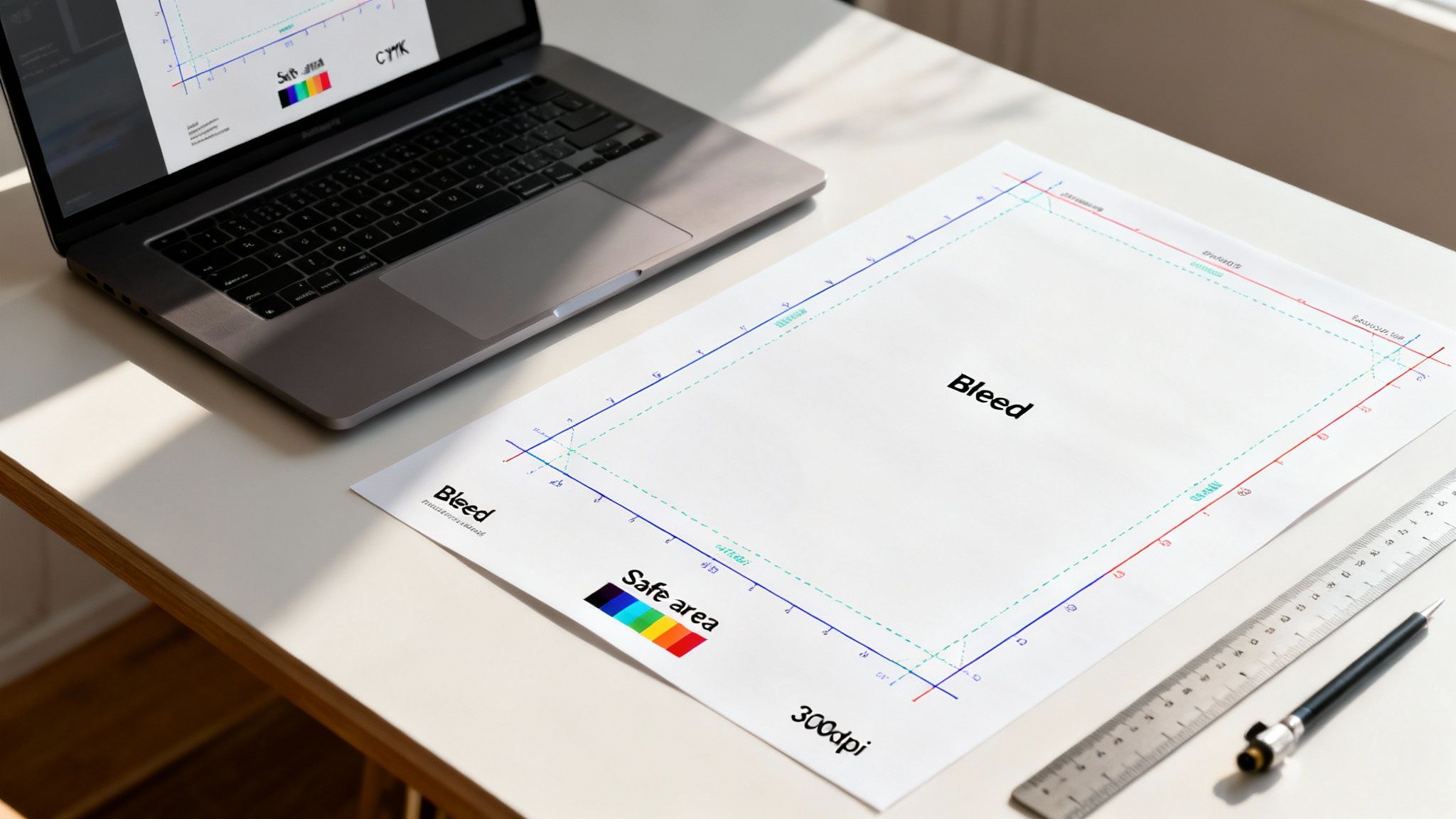
Ever seen a print job with a thin, ugly white border it wasn't supposed to have? That’s what happens when there’s no bleed. A bleed is a small, extra margin of your design (we require 3mm on each side) that extends beyond the final trim line. Posters are printed on larger sheets and then trimmed down to size.
That little bit of extra image ensures that even if the cutting blade is a fraction of a millimetre off, your background colour or image will still go right to the very edge. No white slivers, just a perfect, professional finish.
What is a Safe Area?
The safe area is the inner margin of your design where all your crucial text, logos, and important details should sit. Keeping everything important inside this zone guarantees it won't get accidentally chopped off during the trimming process.
Think of it as a protective bubble for your most important content. By keeping text and logos away from the edges, you ensure your core message stays intact. You can find out more in our detailed guide on what bleed in printing is and why it matters.
Choosing the Best File Format
Finally, saving your file correctly is the last piece of the puzzle. While formats like JPGs are common, they often compress your image data, which can reduce the quality. For the absolute best results, you should always supply your artwork as a print-ready PDF.
A PDF cleverly embeds all your fonts, images, and layout information into one single, reliable file. This means what you see on your screen is exactly what our printers will produce, making it the go-to format for professional printers everywhere.
Choosing the Right Paper and Finish
A brilliant design is only half the story. The paper you choose for your poster has a massive impact on its final look and feel, affecting everything from colour vibrancy to how long it lasts. Getting this right ensures your message isn't just seen, but truly felt.
For example, a lightweight 170gsm silk paper is a fantastic, popular choice for indoor posters. It has a lovely subtle sheen that makes colours pop without causing annoying glare, making it perfect for things like in-store promotions or event announcements. If you want something with a more premium, weighty feel, a 250gsm gloss paper provides a high-shine finish that really grabs attention. It’s ideal for high-quality photo prints or advertising for luxury brands.
Selecting the Perfect Finish
The finish is all about the final aesthetic and where your poster will be displayed. Each option brings something different to the table, depending on what you're trying to achieve with your campaign.
- Gloss Finish: This is your high-shine, super-reflective option that makes colours look incredibly deep and punchy. It’s a great choice for designs that are heavy on photography, but be warned – it can be tough to read under direct light because of the glare.
- Silk Finish: A beautiful middle ground. Silk has a smooth, low-sheen coating that gives you brilliant colour definition, much like gloss, but with far less reflection. This makes it a really versatile and popular choice for most indoor posters.
- Matt Finish: With no shine at all, a matt finish gives a modern, sophisticated look. It’s perfect for posters with a lot of text, as the absence of glare guarantees it’s easy to read from any angle.
Considering Durability and Sustainability
Your choice of paper also says a lot about your poster's lifespan and its environmental footprint. While the UK printing industry has seen its share of changes, large-format printing is still going strong. This is partly thanks to new materials, with sustainable options like recyclable polyester and PVC-free boards becoming more common for environmentally-conscious UK businesses. You can discover more insights about the evolving UK printing market on ibisworld.com.
Picking the right material makes sure your poster not only looks fantastic but also holds up for as long as you need it to. For a deeper dive into how different coatings can protect and enhance your print, have a look at our guide on understanding finishing in printing. A thoughtful choice here elevates your design from a simple piece of paper to a powerful communication tool.
Poster Marketing Ideas for Businesses and Campaigns
Choosing the right poster is much more than a technical decision; it's a strategic marketing choice that can make or break your outreach. By matching the correct poster sizes UK standards offer to specific goals, businesses and political campaigns can turn a simple print into a powerful tool for persuasion.
Effective poster marketing isn't about creating one single design and hoping for the best. Instead, it involves building a cohesive campaign using various sizes, each with a specific job to do. This layered approach ensures your message reaches your audience in different environments, from high-street windows to local community boards.
Business Marketing Ideas
For businesses, posters remain a cornerstone of local advertising. They offer a tangible connection with customers that digital ads often can't, helping to drive footfall and build brand recognition right in your community.
A multi-layered strategy could look something like this:
- A1 Launch Posters: Placed in your shop window and high-traffic local spots to announce a new product or major sale. Their large size ensures they are seen by passing pedestrians and drivers.
- A3 Point-of-Sale Promos: Positioned near tills or product displays to highlight specific offers or add-on deals. They are perfect for influencing purchasing decisions at the last moment.
- A4 Informational Flyers: Placed on countertops for customers to take away. These can contain detailed information, QR codes linking to your website, or vouchers for a future visit.
The UK custom printing market is seeing remarkable growth, with revenues projected to hit around £3.37 billion by 2030. This highlights just how much businesses continue to value high-quality, tangible marketing materials like posters.
Strategies for Political Campaigns
In the political arena, posters are vital for building name recognition and communicating key messages quickly and effectively. A well-organised poster strategy can significantly boost a campaign's visibility on the ground. To create truly impactful marketing, understanding the principles of effective graphic design for branding is essential to make your posters stand out from the crowd.
A political organisation, for example, could use different poster sizes for distinct purposes:
- A1 Campaign Announcements: These large-format posters serve as the main visual for the campaign. They’re ideal for rallies, public squares, and campaign offices to establish a strong presence.
- A2 Supporter Posters: Perfect for supporters to display in their windows at home. They are large enough to be seen from the street but not so big that they become impractical for residential use.
- A4 Leaflets and Canvassing Aids: Essential for door-to-door canvassing. Volunteers can use them to introduce the candidate and leave key policy information with potential voters.
By combining large, attention-grabbing posters with smaller, more detailed formats, a campaign can create a constant and reassuring presence throughout a constituency, reinforcing its message at every turn.
Whether it's for a business or a campaign, a planned approach is key. For more ideas on keeping costs down without sacrificing quality, check out our guide on finding cheap poster printing in the UK.
Your Poster Printing Questions, Answered
To help you get your project over the finish line with confidence, we’ve put together a few answers to the most common questions we hear about poster printing. This quick guide tackles the queries that pop up for everyone, from small businesses to seasoned marketers.
Getting these details sorted from the start makes for a smooth process and a final product you’ll be proud of.
What’s the Most Popular Poster Size for UK Advertising?
For all-round advertising in the UK, the A2 poster (420 x 594 mm) is a firm favourite. It hits that sweet spot of being large enough to get noticed in shop windows, at events, or on community boards, without needing the huge wall space an A1 or A0 demands.
But if you’re after serious, high-impact street-level advertising think A-boards or bus shelters then the A1 poster (594 x 841 mm) is what you need. Its larger scale is brilliant at grabbing the attention of pedestrians and passing traffic, which is why it’s also the top choice for political campaigns that need to make a big impression.
How Do I Choose Between a Gloss or Matt Finish?
The right finish really comes down to your design and where the poster is going to live. Each one has a completely different look and feel, and picking the wrong one can sometimes work against your message.
Here’s a simple breakdown:
- Gloss Finish: This finish has a high shine that makes colours look incredibly punchy and deep. It’s a fantastic choice for posters that are heavy on photography or vibrant graphics. The only catch is that it can create a lot of glare under direct light, which might make text tricky to read.
- Matt Finish: A non-reflective, contemporary finish that gives a more subtle, sophisticated look. It’s hands-down the best choice for text-heavy designs or any poster that will be displayed in a brightly lit space, as it completely kills glare and keeps everything legible.
If you want something in the middle, a silk finish is a great all-rounder. It gives you lovely, rich colours but with a low-sheen surface, making it a popular and versatile option for most indoor posters.
Can I Use a US-Sized Design for UK Printing?
You technically can, but we strongly advise against it. The UK printing industry is built around the ISO 216 'A' series (A4, A3, A2, etc.), which has a completely different aspect ratio to standard US poster sizes like 18" x 24" or 24" x 36".
If you send us a US-sized file, we'll have to resize it to fit the nearest A-series paper. This almost always leads to awkward cropping where parts of your design get cut off, or we have to add unsightly white borders to fill the gaps. For a truly professional result, it’s always best to set your artwork up to the correct UK poster sizes from the get-go.
What’s the Best File Format for High-Quality Poster Printing?
For the crispest, most reliable print results, you should always supply your artwork as a print-ready PDF. It’s the industry standard for a reason—it neatly packages all your fonts, images, and layout elements into one locked-down file.
This ensures that what you see on your screen is precisely what comes off our presses. While we can work with other files like high-resolution JPEGs or TIFFs, a properly saved PDF (with 3mm bleed, in CMYK colour mode, and at 300dpi) is the guaranteed way to get a flawless, professional finish for your poster.
Ready to bring your ideas to life? At The Print Warehouse Ltd, we offer fast, high-quality poster printing in all standard UK sizes to help your business or campaign make a lasting impression. From vibrant A1s to versatile A3s, we have the perfect solution for your needs.
Get started with your poster order today at The Print Warehouse Ltd
Share with Friends & Family:
Related Blogs:
Featured Products: