Size of leaflet: Pick the Right Flyer Size for Your Business
Published on
Choosing the right size of leaflet really comes down to what you want to achieve, how much you want to spend, and how you plan to get it into people's hands. For most UK businesses, the standard 'A' sizes like A5 (148 x 210mm) and A6 (105 x 148mm) hit that sweet spot between having enough space for your message and being kind to your budget.
How to Choose the Right Leaflet Size
Picking a leaflet size might feel like a huge commitment, but it’s more straightforward than you might think. Just picture a standard A4 piece of paper – the kind you’d find in any office printer. The whole 'A' paper system is built on a beautifully simple concept: each size is exactly half of the one before it.
Fold that A4 sheet in half, and you've got an A5. Fold that A5 in half again, and you're holding a pocket-friendly A6. This logical flow makes it easy to visualise just how much room you have to play with. But remember, choosing a size isn’t just about the physical dimensions; it's a strategic move that directly shapes how your message lands.
Matching Size to Strategy
Your decision should always be guided by three key questions: What’s my goal? What’s my budget? How will I distribute it? For instance, a detailed takeaway menu needs the generous space of an A4 or a cleverly folded A5, whereas a simple discount voucher is perfect for a compact A6.
The flowchart below shows just how interconnected your goal, budget, and distribution method are.
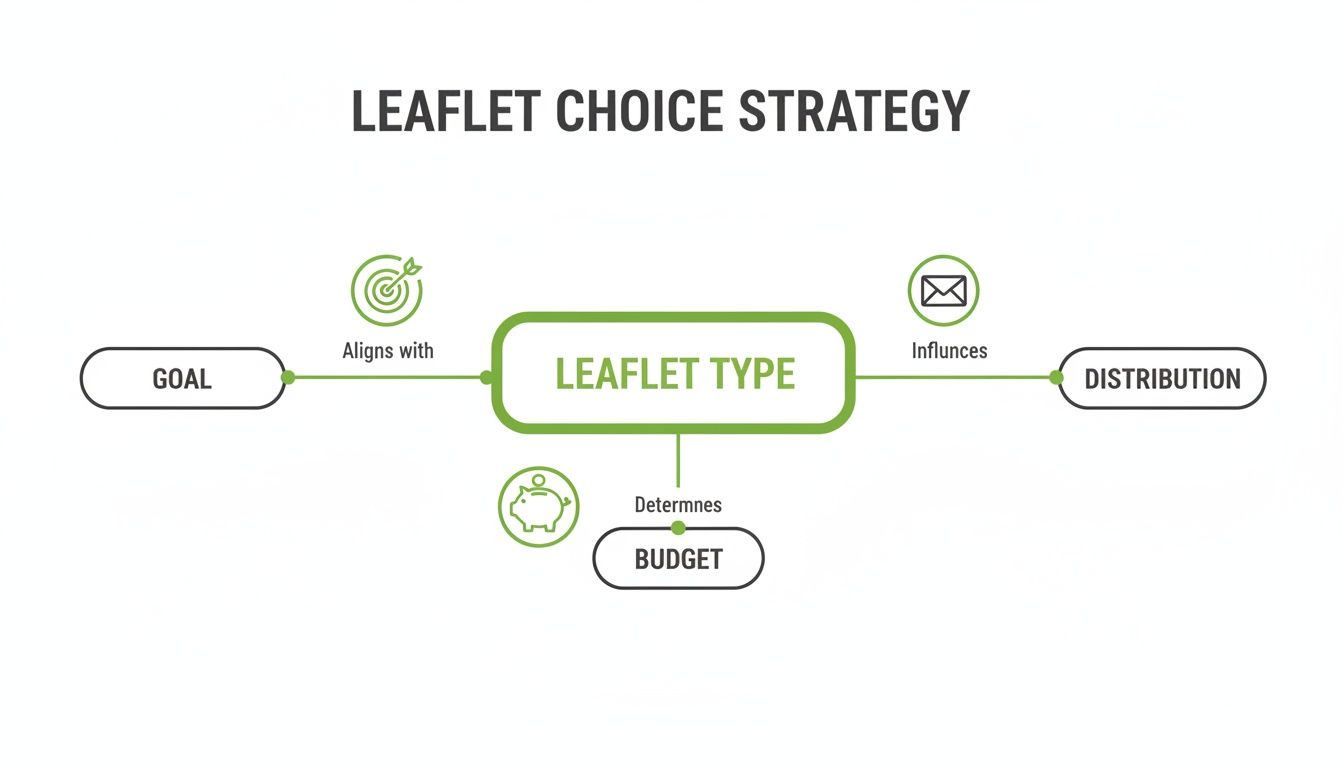
This really drives home that a successful campaign begins by aligning these three elements before you even start thinking about the design. It's also worth taking a step back to figure out if you're creating a flyer or a leaflet in the first place. If you're unsure, you can learn more about how to decide between flyers or leaflets in our guide.
Your leaflet's size is the foundation of its design. It dictates the layout, the amount of text you can include, and even the impression it makes when someone holds it.
At the end of the day, picking the right size is also about reinforcing your brand. It’s a key part of creating cohesive visual branding and ensuring your printed materials feel like they belong to your company. By getting to grips with the standard options, you can make a smart choice that boosts your campaign's impact and delivers a real return on your investment.
A Detailed Look at Standard UK Leaflet Dimensions
Choosing the perfect leaflet size isn't just about what looks good it's about understanding how each dimension works in the real world. Let's move beyond a general overview and get hands-on with the individual A-series sizes, from the roomy A3 right down to the pocket-friendly A7, plus the uniquely shaped DL.
Each size is a different canvas for your message, with its own pros and cons when it comes to cost, portability, and how much information you can comfortably fit. Getting to grips with these details is the secret to matching your leaflet's physical form to your campaign's goals.
A4 Leaflets: The Familiar Standard
Measuring 210 x 297mm, the A4 is the size we all know. It’s identical to a standard sheet of office paper, and its generous surface area makes it the perfect choice for information-heavy documents where every detail counts.
An A4 is brilliant for:
- Detailed Restaurant Menus: Plenty of space for descriptions, prices, and mouth-watering images without feeling cluttered.
- Technical Spec Sheets: Ideal for showcasing product features, diagrams, and data clearly.
- Informative Guides: Great for step-by-step instructions or detailed event programmes.
The only real drawback is its size. An A4 leaflet can feel a bit cumbersome to carry around, which is why it's often folded to be more manageable—though this can add a little to the cost and complexity.
A5 Leaflets: The Versatile Favourite
At 148 x 210mm, the A5 is exactly half the size of an A4 and is, without a doubt, the most popular and versatile leaflet out there. It strikes that perfect balance between having enough room for a compelling message and being small enough for easy distribution. It’s also incredibly cost-effective for bulk printing, making it a go-to for countless businesses.
This size is a winner for:
- Event promotions
- Retail sale announcements
- Small business introductions
The A5 leaflet is the true workhorse of the print marketing world. It’s large enough to make a real visual impact but small enough to be slipped into a bag or popped through a letterbox without needing a fold.
A6 Leaflets: The Pocket Powerhouse
Measuring 105 x 148mm, the A6 is the same size as a standard UK postcard. This compact format is fantastic for short, punchy messages designed to be kept and used later. It’s incredibly portable and cheap to print in large numbers, making it perfect for mass distribution at events or as a handout.
Think of an A6 for things like:
- Appointment reminder cards
- Vouchers and discount codes
- Event admission tickets
DL Leaflets: The Professional Fit
The DL (which stands for Dimension Lengthwise) is a tall, slim format measuring 99 x 210mm. It’s exactly one-third of an A4 sheet and is designed to slide perfectly into a standard DL envelope, making it a sharp, professional choice for direct mail campaigns. Its unique shape really helps it stand out from the more common A-series sizes.
Whether you're crafting a detailed menu or a compact voucher, you can explore the full range of options in our high-quality leaflet printing services to find the perfect fit for your project.
How to Match Your Leaflet Size to Your Distribution Plan
A killer design on beautiful paper is fantastic, but it can all fall apart if the leaflet size doesn't work with how you plan to hand it out. Thinking about your distribution method from the very beginning isn't just a boring logistical step—it’s a massive part of your campaign strategy that directly impacts your costs, how people react, and whether you succeed or fail.
The journey your leaflet takes to land in a potential customer's hands is just as important as the message it carries. A format that’s a knockout for one delivery method could be a total dud for another. Getting this right is how you make sure your marketing budget is working as hard as it can.
The Best Sizes for Common Distribution Methods
Let's get practical and look at which leaflet sizes are best suited for different distribution channels. This choice affects everything from postage costs to how likely someone is to actually keep your leaflet.
-
Door-to-Door Drops: When posting through letterboxes, A5 is the undisputed champion. It’s big enough to feel important and stand out from the daily post, but small enough to slide through a standard letterbox without getting mangled. Using a slightly heavier paper stock here also gives it a more premium feel on arrival.
-
In-Person Handouts: At a bustling trade show, networking event, or on the high street, portability is everything. An A6 leaflet is your best friend here. It’s the perfect size for someone to pop into a pocket or a bag, which means they're far more likely to take it home instead of ditching it in the nearest bin.
-
Magazine or Newspaper Inserts: For this channel, you need to be mindful of weight and size to keep your costs in check. A lightweight A5 or a slim DL leaflet is the way to go. They’re cheap to produce in bulk and won’t add much weight to the publication they’re tucked inside.
Think about the entire life of your leaflet. Where will it end up after it leaves your hands? The answer to that question should be a major factor in deciding its size and shape.
The Staying Power of Direct Mail
For blanketing a large area, you really can't beat direct mail. In the UK, Royal Mail's Door to Door service is a behemoth, reaching over 29 million households across the nation. The whole operation is broken down into 9,360 super-local postal sectors, each with about 3,099 households on average. Knowing this helps you plan incredibly targeted campaigns where the leaflet size is perfectly optimised for postal delivery.
At the end of the day, the right leaflet size is simply the one that works hand-in-glove with your distribution plan. When you think through the practical side of delivery, you give your message the best possible chance of not just looking great, but actually reaching the people you want to see it. When you're ready to get printing, you can explore our full range of flyers and leaflets to find the perfect fit for your campaign.
Exploring Folds, Creative Formats, and Orientation
A flat sheet of paper is one thing, but the real magic happens when you add a fold. Suddenly, a simple leaflet transforms into something interactive. It creates a mini-experience, guiding your customer through the information panel by panel.
Think about it – a fold adds a sense of discovery. Instead of seeing everything at once, your audience is encouraged to open it up and explore what’s inside. This makes even dense information feel far more manageable and less intimidating than plastering it all over one big sheet.
Common Fold Types and Their Uses
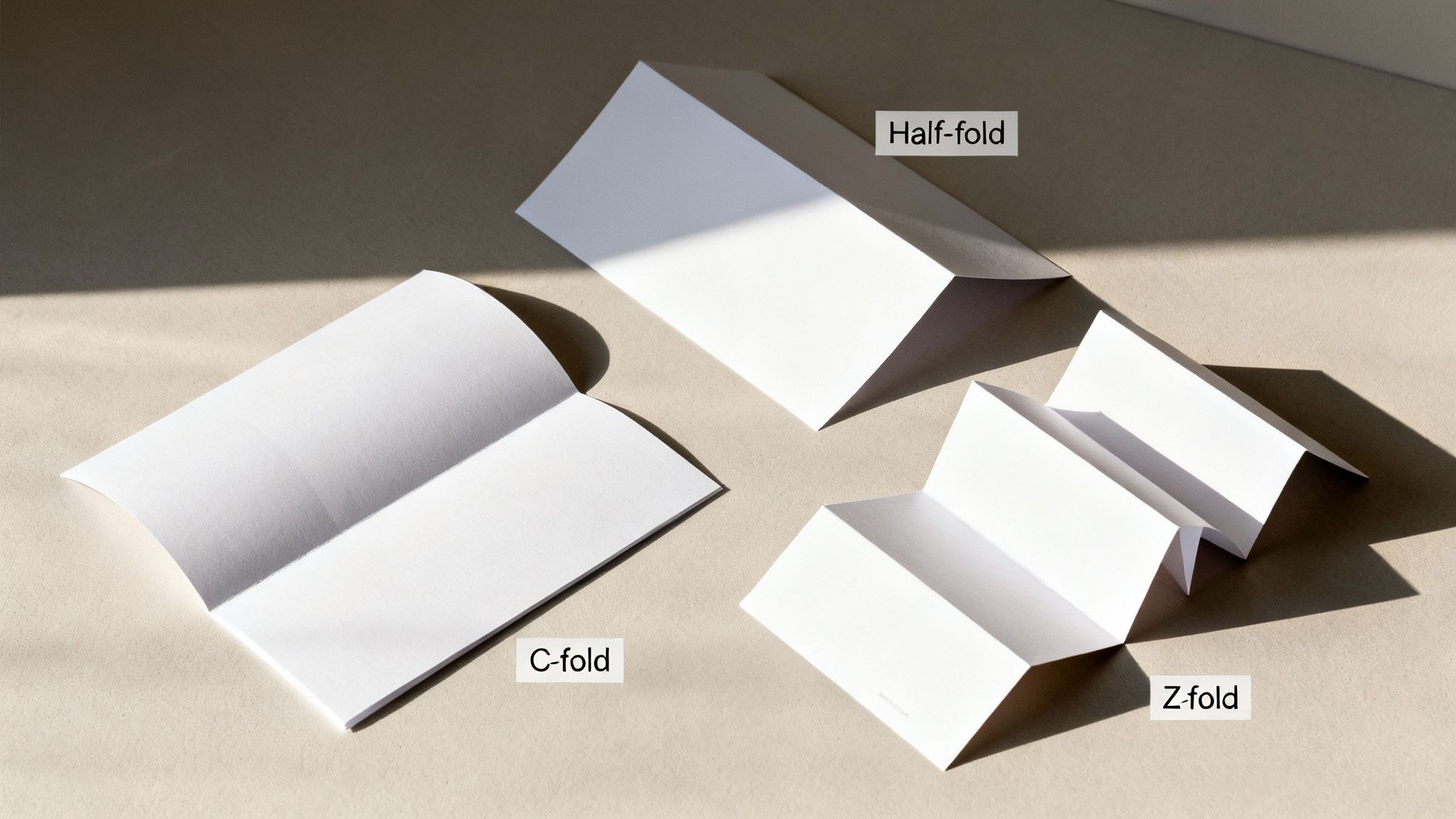
While you can get pretty creative with folds, there are three classic styles that cover almost every need. Each one creates a totally different reading journey and works best for certain types of content.
-
Half-Fold: This is the simplest of the lot. Just fold the paper once down the middle, like a greetings card. This gives you four distinct panels (a front, a back, and two inside pages). It’s perfect for simple presentations, event programmes, or menus where you don't need to overcomplicate things.
-
C-Fold (or Letter Fold): Imagine folding a letter to pop in an envelope. A standard A4 sheet is folded into thirds, with one side folding in first, and the other folding over to create a cover. This gives you a neat six-panel leaflet with a proper front page, making it a classic for marketing brochures and informational guides.
-
Z-Fold (or Accordion Fold): Also folded into thirds, the Z-fold creates a zigzag or accordion shape. All six panels are the same width, and it opens up to reveal a large, seamless spread. This makes it brilliant for designs that flow across panels, like timelines, big maps, or step-by-step instructions.
By folding a leaflet, you are not just saving space; you are choreographing the way your information is received. Each panel becomes a stage for a specific part of your message, building suspense and encouraging interaction.
Choosing Your Leaflet Orientation
Finally, don’t forget about orientation. It might seem like a small detail, but choosing between portrait (vertical) and landscape (horizontal) completely changes the feel and flow of your design.
Portrait is the traditional, go-to choice. It works well for lists, text-heavy content, and classic layouts. Landscape, on the other hand, can feel more modern and cinematic. It gives you a wider canvas that’s perfect for stunning photography, wide graphics, and designs that really grab attention. The right choice depends entirely on the story you want your leaflet to tell.
By getting to grips with these simple techniques, you can turn a basic print job into a genuinely powerful marketing tool. If you're ready to bring these ideas to life, you can explore the full range of high-quality folded leaflets we offer.
How to Prepare Your Artwork for a Perfect Print
A brilliant design deserves an equally brilliant print. But to get from the design on your screen to a perfect physical leaflet, there are a few technical hoops to jump through. Getting these details right is the secret to ensuring your final product looks exactly as you imagined, with crisp images and vibrant colours.
Think of it as a pre-flight checklist for your artwork.
Bleed, Trim, and the Safe Area
These terms might sound a bit jargony, but they are your best friends when it comes to avoiding disappointing white borders or seeing your key message get trimmed away. Understanding them is simple and guarantees your design translates perfectly from the screen to the paper.
-
Bleed: This is an extra border of your design, usually 3mm on all sides, that goes beyond the final cut line. Printing and trimming machines are incredibly precise, but there's always a tiny margin of movement. The bleed is your insurance policy—if the cut is a fraction of a millimetre off, the blade will slice through your background colour or image, not a sliver of blank paper. Your backgrounds should always fill this area.
-
Trim: This is the finish line. It’s the exact edge where the guillotine will cut your leaflet to its final size. For an A5 leaflet, this is the 148 x 210mm boundary.
-
Safe Area: This is an inner safety zone, typically another 3mm inside the trim line. You must keep all your crucial text, logos, and important design elements comfortably within this area. This guarantees nothing vital gets accidentally clipped during the final trim.
Think of the bleed as your safety net. By extending your design beyond the trim line, you give the printing press a margin for error, guaranteeing a professional, edge-to-edge finish every single time.
Resolution and Colour Mode
To get that sharp, professional look, your artwork file needs to be set up correctly from the very start. It all comes down to two things: resolution and colour.
First up, your images need a resolution of at least 300 DPI (dots per inch). Images on websites often use 72 DPI to help pages load quickly, but if you print that, it will look fuzzy and pixelated. 300 DPI is the industry standard for high-quality, razor-sharp results. It's a non-negotiable for professional printing.
Next, make sure your file is set up in CMYK (Cyan, Magenta, Yellow, Key/Black) colour mode, not RGB (Red, Green, Blue). Your screen creates colour by mixing red, green, and blue light (RGB), but a printing press uses cyan, magenta, yellow, and black inks (CMYK). Designing in CMYK from the beginning prevents any unexpected colour shifts when your leaflet comes off the press.
To ensure your leaflet artwork is prepared flawlessly for printing, consider engaging an expert graphic designing company who can handle these technical details for you. Finally, always save your final file as a press-ready PDF. This format locks in all your design information, fonts, and images, so what you see on your screen is what we'll print.
Why Paper Stock and Finishes Matter
You've nailed down the perfect size for your leaflet, but how it feels in someone's hand can say just as much about your brand. This is where paper stock and finishes come in, transforming a simple piece of paper into a powerful statement.
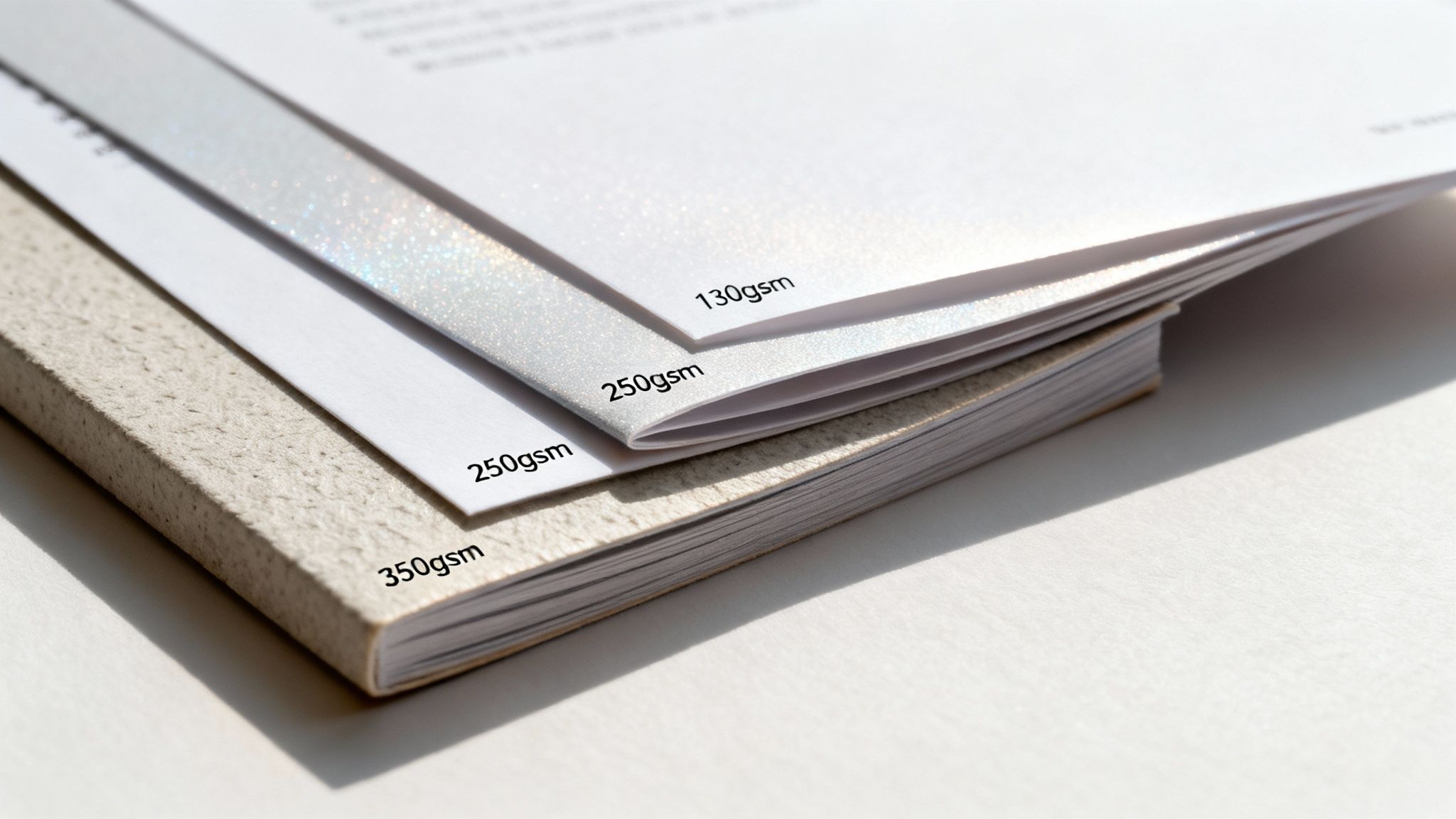
The weight of the paper, measured in GSM (Grams per Square Metre), is your best clue to its quality. Simply put, a higher GSM means a thicker, more substantial piece of paper. This isn't just a technical detail; it has a huge impact on how a customer perceives your business.
Finding the Right Weight and Feel
Think about the message you want to send. Your local takeaway dropping off menus might opt for a budget-friendly 130gsm paper. It’s light, gets the job done, and is perfect for mass distribution without breaking the bank.
But what about a high-end spa promoting a luxury treatment package? A flimsy leaflet just won't cut it. They'd be much better off with a premium 350gsm card stock. It feels important, valuable, and immediately reflects the quality of the service on offer.
The weight and finish of your leaflet are like a non-verbal handshake with your customer. A flimsy, thin paper suggests a budget operation, while a thick, smooth card communicates professionalism and quality.
Beyond the weight, the finish you choose adds another layer of personality.
- Gloss Finish: This shiny, reflective coating makes colours pop. It’s fantastic for designs loaded with photos, giving them a vibrant, punchy look while adding a protective layer against marks and moisture.
- Matt Finish: For a more modern and sophisticated feel, a matt finish is perfect. Its smooth, non-reflective surface is ideal for elegant, text-heavy designs and feels great to the touch, suggesting an understated class.
Matching these elements to your brand is what makes all the difference. That luxury spa might choose a thick, matt-laminated card for a subtle, premium feel. The takeaway, on the other hand, is better served by a durable, glossy finish that makes their food photography look irresistible.
And if sustainability is important to you, it's worth exploring our range of high-quality recycled flyers that still feel fantastic. It's all about making choices that go beyond the visual to create a truly memorable impression.
Still Deciding on Your Leaflet Size?
Got a few lingering questions before you hit 'print'? No problem. We get these all the time, so let's clear them up.
What’s the Most Popular Leaflet Size in the UK?
Hands down, the A5 leaflet (148 x 210mm) is the crowd favourite, and for good reason. It hits that sweet spot – big enough to fit your message without being overwhelming, but small enough to be handy. It’s the go-to for countless businesses because it’s incredibly cost-effective for big print runs and just the right size for door drops and event handouts.
Should I Go for Portrait or Landscape?
Honestly, this one’s all about your content and the vibe you're going for. Portrait (vertical) is the classic choice. It’s perfect for lists, text-heavy designs, or any time you want a traditional, easy-to-read layout.
On the other hand, landscape (horizontal) flips the script. It feels more modern and cinematic, giving you a wider canvas to show off stunning photography or bold, wide graphics. Think about what you want to showcase and let that guide your decision.
How Much Does Paper Weight Really Matter?
More than you might think! The paper weight, measured in GSM (Grams per Square Metre), is one of the first things a customer will notice. It's all about perception.
A lighter 130gsm paper is brilliant for mass mailouts or large-scale promotions where budget is key. But if you want to make a real statement, a heavier 250-350gsm stock feels premium and substantial in the hand. It instantly communicates quality and shows you mean business. Your choice sends a message before they’ve even read a word.
Choosing the right leaflet size isn't just a practical step; it's a strategic one. It influences everything from your design options and distribution costs to how people feel about your brand. If you're unsure, don't be afraid to order some samples to see and feel the difference yourself.
And a final pro tip: always check the print specs! Adding a 3mm bleed is non-negotiable for getting that perfect, edge-to-edge finish.
Ready to create leaflets that people actually want to keep? From compact A6 flyers to detailed folded brochures, The Print Warehouse Ltd has the perfect size and finish for your project. Explore our full range and get an instant quote at https://theprintwarehouse.uk.
Share with Friends & Family:
Related Blogs:
Featured Products: