What Size Is A2 in CM Explained for Perfect Prints
Published on
Right, let's get straight to it. An A2 sheet of paper measures exactly 42 cm by 59.4 cm. This standard size is a versatile favourite for everything from eye-catching event posters to detailed architectural plans.
Your Quick Guide to A2 Paper Size
Getting your head around the precise dimensions of A2 is the first step towards a flawless print project. Knowing the A2 size in centimetres is essential, but if you're working on a digital design or sending files internationally, it's just as important to know its equivalents in other units.
The A2 paper size is part of the ISO 216 international standard, which has been the cornerstone of UK printing since 1975. This clever system ensures that paper sizes are consistent all over the world, making design and printing predictable and wonderfully efficient. For anyone preparing a file for print, getting these digital dimensions right from the very start is critical.
For a high-quality A2 print, the industry standard resolution is 300 dots per inch (DPI). In digital terms, this translates to a canvas of 4,961 x 7,016 pixels.
Nailing these numbers at the beginning of your project is the best way to avoid common headaches like pixelation or blurry images. In fact, a 2023 survey found that a staggering 72% of UK printers frequently receive files with pixel errors, which can cause costly and frustrating delays.
To make things easy, here’s a simple table to help you visualise the A2 size across different units. It's the perfect cheat sheet to ensure your artwork is set up perfectly for professional results with our poster printing service.
A2 Size Conversion Chart
| Unit | Width | Height |
|---|---|---|
| Centimetres (cm) | 42.0 cm | 59.4 cm |
| Millimetres (mm) | 420 mm | 594 mm |
| Inches (in) | 16.5 in | 23.4 in |
Keep this chart handy when you're setting up your design files, and you'll be well on your way to a perfect print.
How Big Is A2 Paper in the Real World?
Numbers on a screen can feel a bit abstract, so let's put the A2 size into perspective. The easiest way to picture it is by imagining four standard A4 pages—the kind you use in your office printer—arranged in a perfect 2x2 grid. That combined area is exactly one A2 sheet.
This clever relationship is the secret behind the ISO 'A' paper series. Each size is precisely half of the one before it. An A1 sheet folded in half becomes an A2, and an A2 folded in half becomes an A3. This simple logic makes scaling documents for printing incredibly straightforward.
A2 strikes a perfect balance between impact and manageability. It’s large enough to command attention from a distance but not so big that it becomes difficult to handle or find a place to display.
This balance is exactly why A2 is such a popular choice for all sorts of visual media, from posters to professional plans.
Visualising A2 in Different Units
To get your design print-ready, you need to understand how the physical size translates into other units. You'll work with centimetres for scale, millimetres for precision, and pixels when creating your digital artwork. Getting this hierarchy right is key to a flawless final print.
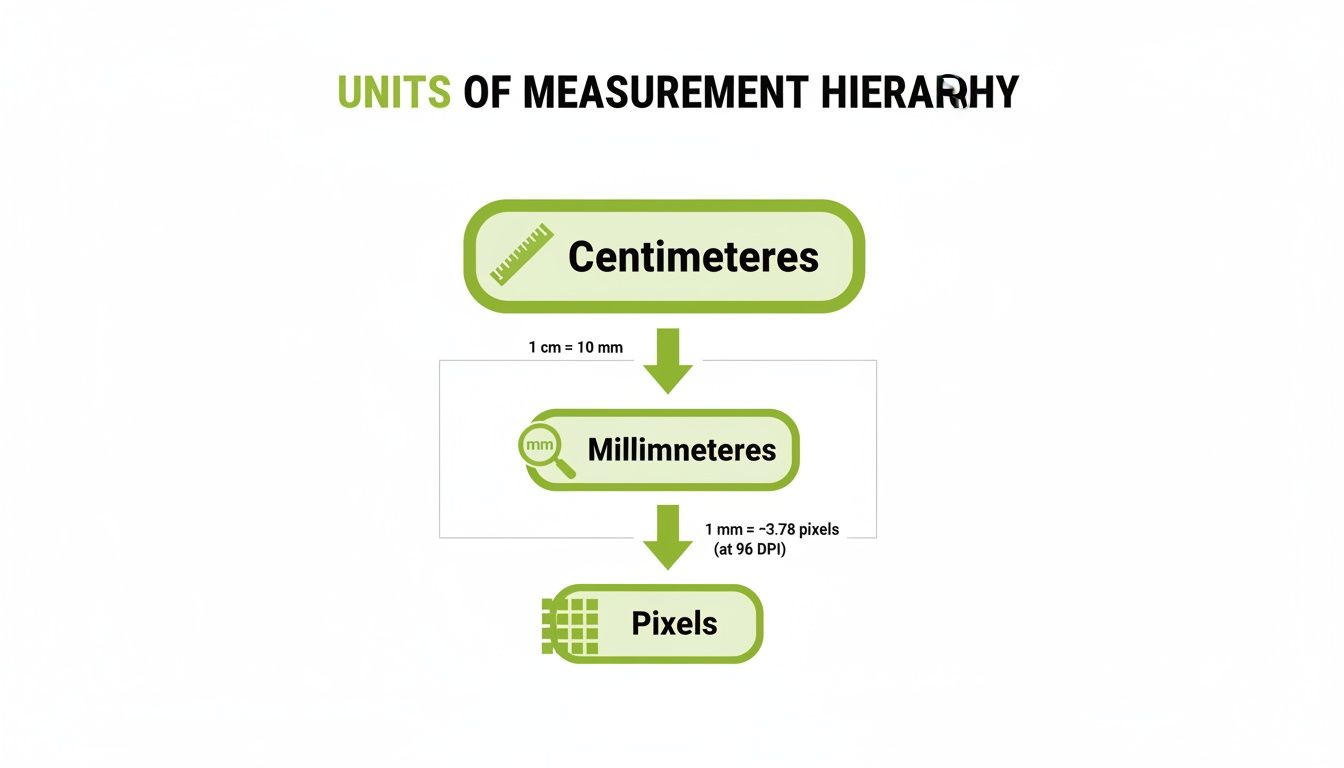
This visual shows the direct conversion path, from the overall dimensions in centimetres down to the pixel count needed for a high-resolution file.
In the UK, A2—at 42 x 59.4 cm—is the go-to for posters and notices. It’s slightly larger than a traditional broadsheet newspaper, giving you a generous canvas to work with.
Its substantial size makes it ideal for everything from small café window displays to detailed architectural drawings and vibrant art prints. When you need to showcase detail without overwhelming a space, our range of indoor posters in A2 offers a fantastic solution.
Where You Will See A2 Paper Being Used
Now that you can picture its scale, let’s explore where the A2 size truly shines. Its dimensions of 42 x 59.4 cm make it a powerhouse in visual communication, striking that perfect balance between grabbing attention and fitting comfortably into different spaces.
Chances are, you’ve seen countless A2 prints out in the wild without even realising it. Think about the vibrant gig posters plastered on a venue wall or the special offers proudly displayed in a shop window. That’s A2 in action—it’s the go-to format for effective, local advertising.
It’s large enough to feature bold graphics and text that people can actually read from a distance, but it’s compact enough not to overwhelm its surroundings. This sweet spot makes it a firm favourite across dozens of industries.
Common Commercial and Creative Uses
The sheer practicality of A2 paper makes it a staple for all sorts of professional and artistic projects. Its generous surface area allows for real detail and impact, making it ideal for everything from visual storytelling to sharing important information.
Here are a few of the most popular places you'll find it:
- Event Posters: Concerts, local festivals, and community gatherings all lean on A2 posters for promotion. They’re big enough to get noticed on a crowded bulletin board or lamppost.
- Retail and Point-of-Sale Displays: Those in-store promotions, new product announcements, and sale signs often use the A2 format to capture a shopper's attention right when it matters most.
- Architectural Plans and Technical Drawings: Architects and engineers often use A2 to display detailed schematics and floor plans. It provides plenty of space for precision without becoming a nightmare to handle on-site.
- Art Prints and Photography: For artists and photographers, A2 is an excellent size for selling high-quality prints. It makes a real visual statement on a wall while still being relatively affordable to frame and ship.
A2 is the unsung hero of visual media. It delivers professional impact for everything from academic presentations and business portfolios to trade show graphics. Its size ensures your message is seen and respected.
Planning for Exhibitions and Events
When you’re getting ready for a larger event, A2 prints are incredibly useful for directional signage, information boards, and promotional displays. Their consistent sizing helps you create an organised, professional-looking setup.
For businesses heading to trade shows, understanding how different print sizes work together is key. You can find more tips on preparing materials for professional displays by exploring our guides on printing for exhibitions. Ultimately, whether you’re setting up a gallery wall or a conference booth, A2 provides a reliable and impactful canvas.
Getting Your A2 Artwork Ready for Print
Taking your design from a digital screen to a physical A2 print involves a few crucial steps. It might sound technical, but with a bit of know-how, you can make sure your final product looks exactly as you imagined it.
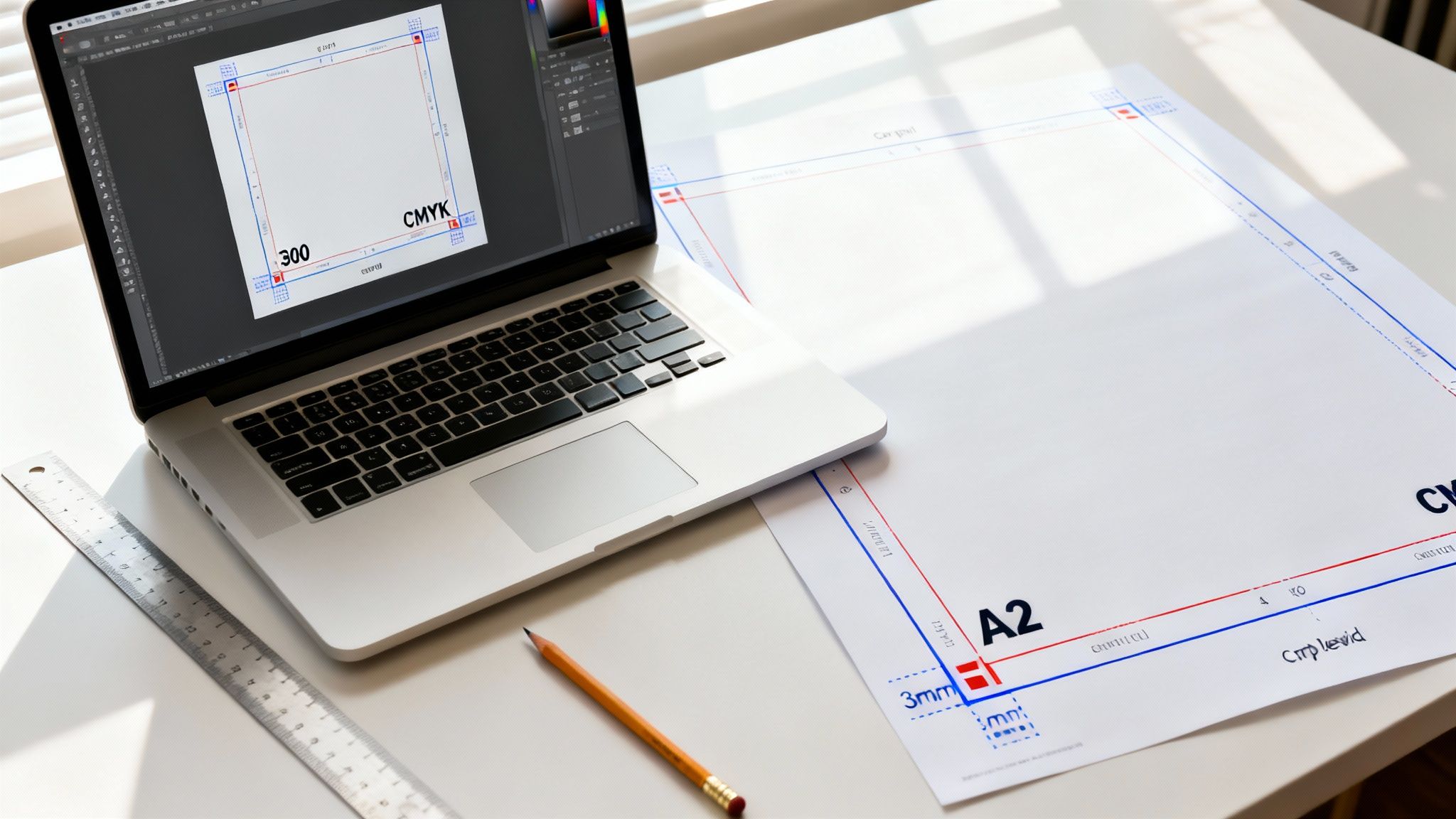
First up, let's talk about clarity. The sharpness of your printed image all comes down to its resolution, which we measure in dots per inch (DPI). For a professional A2 print, 300 DPI is the non-negotiable standard. This guarantees every detail is crisp and clear, helping you avoid that dreaded pixelated or blurry finish you get from low-resolution files.
To put it in perspective, a high-quality A2 print at 300 DPI is made up of around 35 million pixels. Trying to get by with less is a common and costly mistake. In fact, a 2021 report revealed that 19% of all print rejections in the UK were due to low-resolution files. It’s a simple check that saves a lot of headaches.
Essential Pre-Print Checklist
Next is colour accuracy. Your screen displays colours using an RGB (Red, Green, Blue) model, but professional printers run on CMYK (Cyan, Magenta, Yellow, Black). If you set your design file to CMYK right from the start, the colours you see on your monitor will be a much closer match to the final printed version.
Finally, you absolutely need to add a bleed. A bleed is a small extra margin—usually 3mm on each side—that extends your design beyond the final trim line. This clever addition prevents any unsightly white edges if the paper shifts slightly during cutting, giving you a clean, seamless finish.
Think of the bleed area as a safety net for your design. It ensures that crucial elements aren't accidentally trimmed off and that your background colour extends right to the very edge of the paper for a polished, professional look.
If you’re digitising a physical piece for your A2 print, it's also worth knowing how to properly photograph artwork for prints.
By mastering these simple steps 300 DPI, CMYK colour, and a 3mm bleed you can send your file to print with total confidence. And for really durable, high-impact displays, our services for rigid board printing are an excellent option for perfectly prepared A2 artwork.
Choosing the Right Paper for Your A2 Project
Getting the A2 size spot on is only half the battle; the paper you choose is what truly brings your design to life. It's just as crucial as the artwork itself, defining the final look, feel, and quality of your print. The decision really boils down to two things: the paper’s weight and its finish.
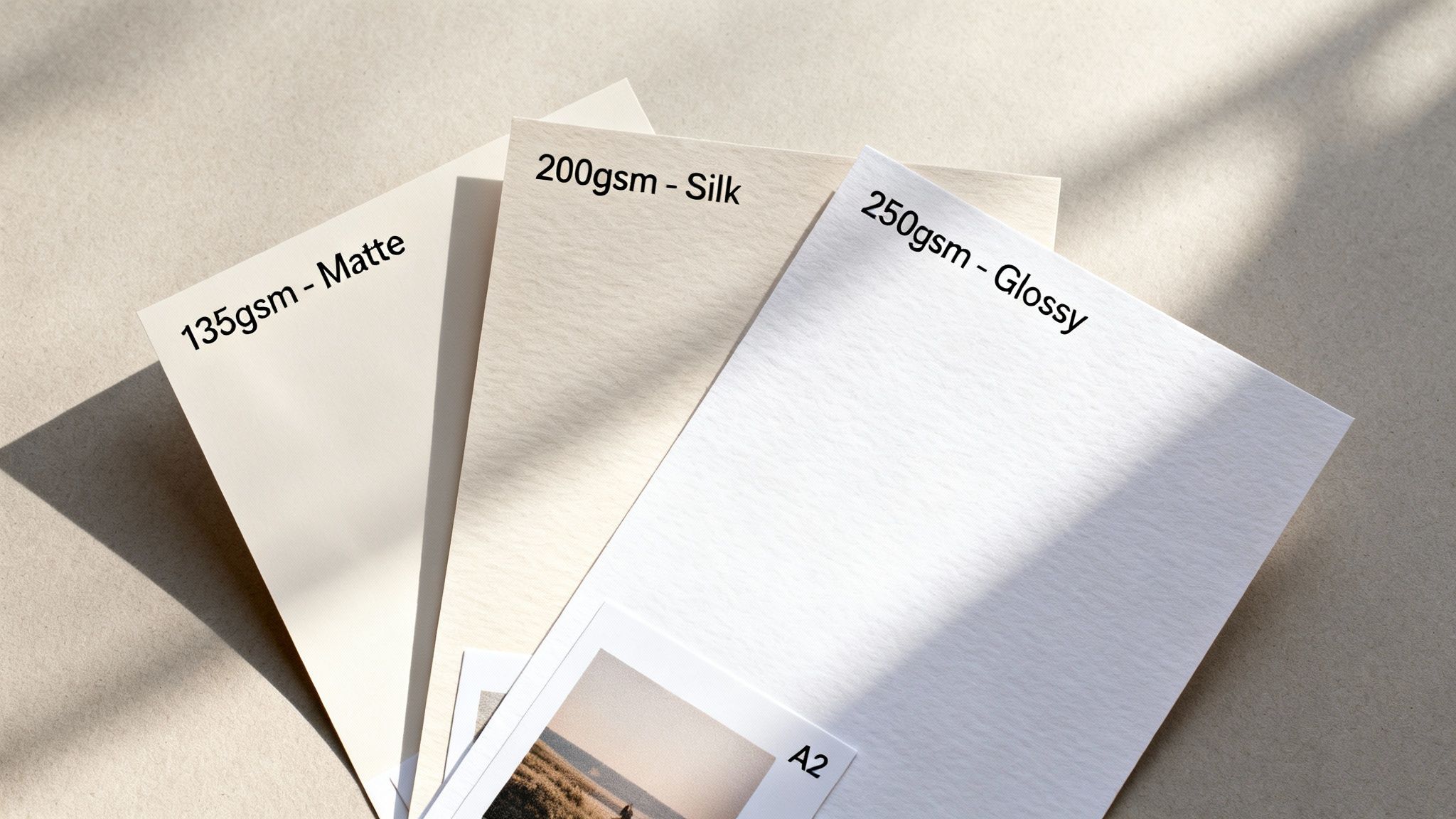
We measure paper weight in Grams per Square Metre (GSM). Simply put, a higher GSM means a thicker, sturdier paper that feels more substantial in your hands.
Think of GSM like the thread count in bedsheets. A lightweight 135gsm paper is brilliant for temporary indoor posters, but a heavyweight 250gsm stock gives you the rigidity needed for fine art prints or important displays that need to last.
Selecting the Perfect Finish
Once you've settled on a weight, it's time to pick a finish. Each one interacts with light differently, which can completely change the mood and appearance of your final print. Your choice should line up with your project's goals and overall aesthetic.
Here’s a quick rundown of the most popular options:
- Glossy: With its high-shine finish, gloss makes colours look incredibly vibrant and punchy. It’s perfect for photographic prints or any design you want to grab attention, but keep in mind it can create a bit of glare under direct light.
- Matt: A matt finish is completely non-reflective, offering a modern, understated, and sophisticated feel. It's a fantastic choice for designs with a lot of text or for prints that will be displayed in brightly lit spaces.
- Silk: Offering a beautiful middle ground, silk has a subtle, low-sheen coating that adds a touch of class without the full-on shine of gloss. It’s a wonderfully versatile and very popular choice for professional posters and portfolios.
And what if your print is heading outdoors? For projects in damp areas or exposed to the elements, you’ll need something tougher. Our range of waterproof posters ensures your A2 prints stay looking sharp, whatever the weather throws at them.
Your A2 Questions Answered
To round things off, let's tackle some of the most common questions we get about A2 paper. This should clear up any lingering queries you have before you send your next project to print.
How Many A4 Sheets Fit Into an A2?
You can fit exactly four A4 sheets perfectly into a single A2 page.
A simple way to picture this is to lay two A4 pages side-by-side in a landscape orientation, then place another two directly below them. This 2x2 grid creates the exact 42 x 59.4 cm footprint of an A2 sheet.
Is A2 a Good Size for a Poster?
Absolutely. In fact, A2 is one of the most popular and effective sizes for posters. It hits that sweet spot between being large enough to grab attention in busy places like shop windows or event halls, but not so big that it becomes a hassle to hang.
For a professional A2 print that looks sharp and clear, your image file needs to be set to a resolution of 300 dots per inch (DPI). This means your digital canvas should be 4961 x 7016 pixels. Anything less, and you risk a blurry or pixelated result.
Is A2 Bigger Than A3?
Yes, an A2 sheet is much larger than an A3. To be precise, A2 is exactly double the size of A3.
If you take an A2 sheet and fold it in half along its longest edge, you'll end up with two perfectly sized A3 sheets. It’s all part of the clever ISO paper system.
Ready to bring your A2 designs to life? At The Print Warehouse Ltd, we offer high-quality, professional printing to make your posters and boards stand out. Start your print order today
Share with Friends & Family:
Related Blogs:
Featured Products: