A Guide to cheap leaflets printing uk: Save on Marketing with Smart Paper
Published on
Finding cheap leaflets printing UK services isn't about guesswork; it's about understanding which levers to pull. The sweet spot for value usually involves standard sizes like A5 or DL, printed on a reliable paper like 130gsm or 150gsm gloss, and allowing a slightly longer turnaround time. This combination helps printers maximise efficiency on their print runs, and they pass those savings on to you.
Decoding the True Cost of Leaflet Printing
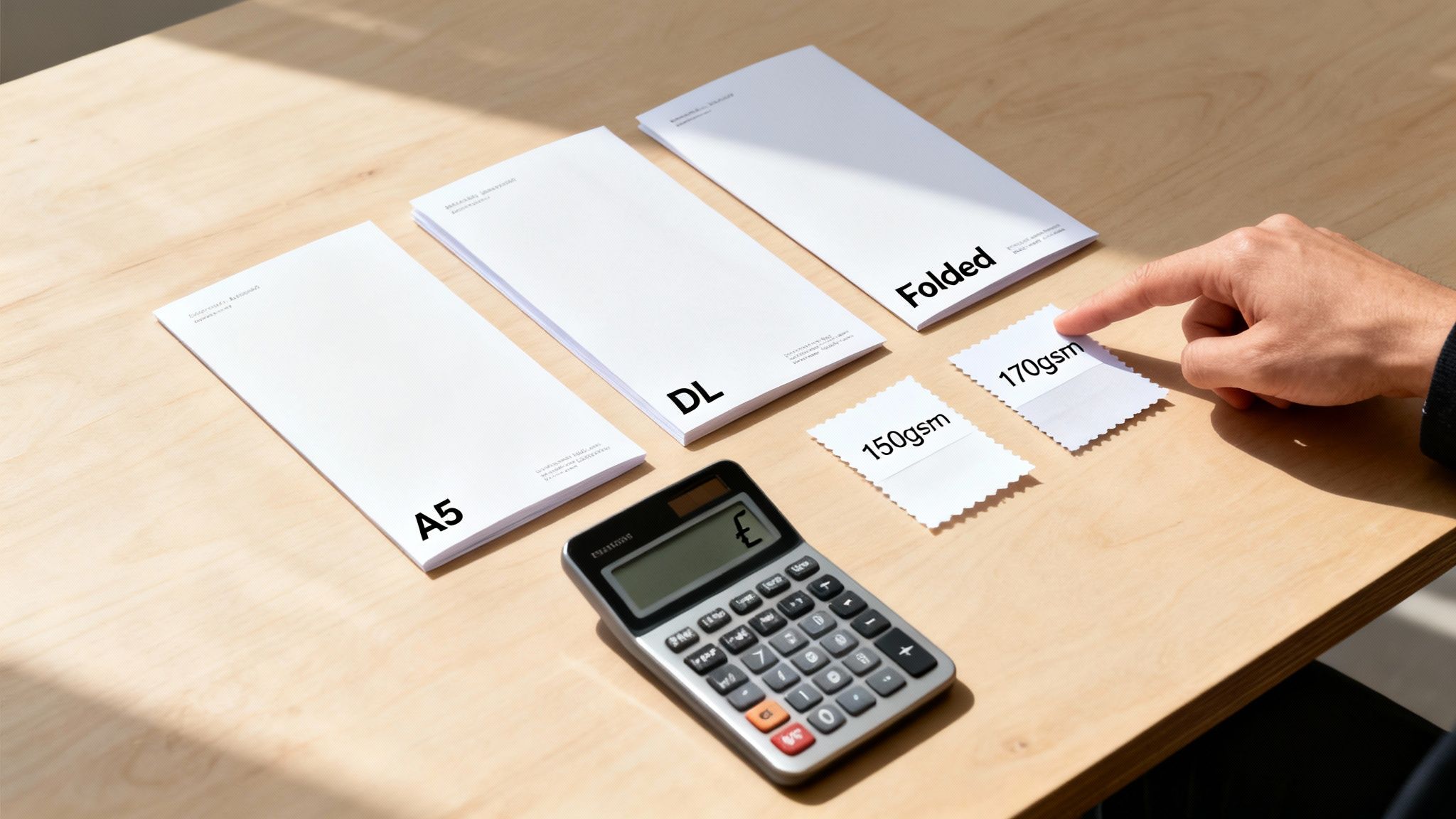
Before you can spot a genuinely good deal, you need to know what 'cheap' really means in the world of professional printing. It’s not about cutting corners or accepting poor quality. It’s about making smart, informed choices that match your budget to your marketing goals. Every decision from the paper's thickness to its finish directly impacts your final invoice.
The UK printing industry is a bustling marketplace. In 2025, it’s valued at around £9.2 billion, with something like 7,800 firms all vying for your business. This fierce competition is fantastic news for savvy buyers because it keeps prices competitive and pushes printers to offer real value.
Key Cost Drivers You Control
There are a few core elements that really dictate the price of your leaflet order. By tweaking these, you can bring costs down significantly without watering down your campaign's impact.
- Paper Weight (GSM): This is just a measure of paper thickness (grams per square metre). A hefty 300gsm stock feels undeniably premium, but for mass distribution, a 150gsm paper is a brilliant workhorse. It feels professional in the hand but costs a fraction of the price.
- Paper Finish: Your main choices are usually gloss or silk. A gloss finish makes colours pop and adds a protective sheen, while a silk finish has a smoother, more subtle feel. For pure economy, gloss is often the way to go.
- Leaflet Size: Standard sizes like A5 and DL are almost always cheaper than custom dimensions. Why? Because they fit perfectly onto large press sheets, which means less paper waste for the printer and a lower price for you.
Pro Tip: Don't automatically assume a single-sided leaflet is dramatically cheaper. The ink is a tiny part of the overall cost compared to paper and machine setup. Printing on both sides often gives you double the marketing space for a very small price increase, making it a much better return on investment.
A Real-World Scenario
Picture a local coffee shop wanting to print 5,000 leaflets for a new loyalty scheme. They might initially ask for a quote on a premium 250gsm silk A5 leaflet.
But by simply switching to a standard 150gsm gloss A5 leaflet, they could slash their printing bill by 20-30%. That’s a huge saving for a handout campaign where the leaflet’s job is to deliver information quickly, and it frees up cash to put towards distribution or other marketing.
Knowing the difference between various print formats can also steer your design and cost decisions. If you're weighing your options, have a look at our guide on how to decide between flyers or leaflets for more ideas on which format will work best for you.
Choosing Your Specs for Maximum Impact
Alright, now you know what drives the cost of leaflet printing. It’s time to put that knowledge to work and choose specs that actually deliver results. This isn’t about just picking the cheapest option; it’s about finding the most valuable combination for your goal. A leaflet for a high-end spa and one for a local takeaway have completely different jobs to do.
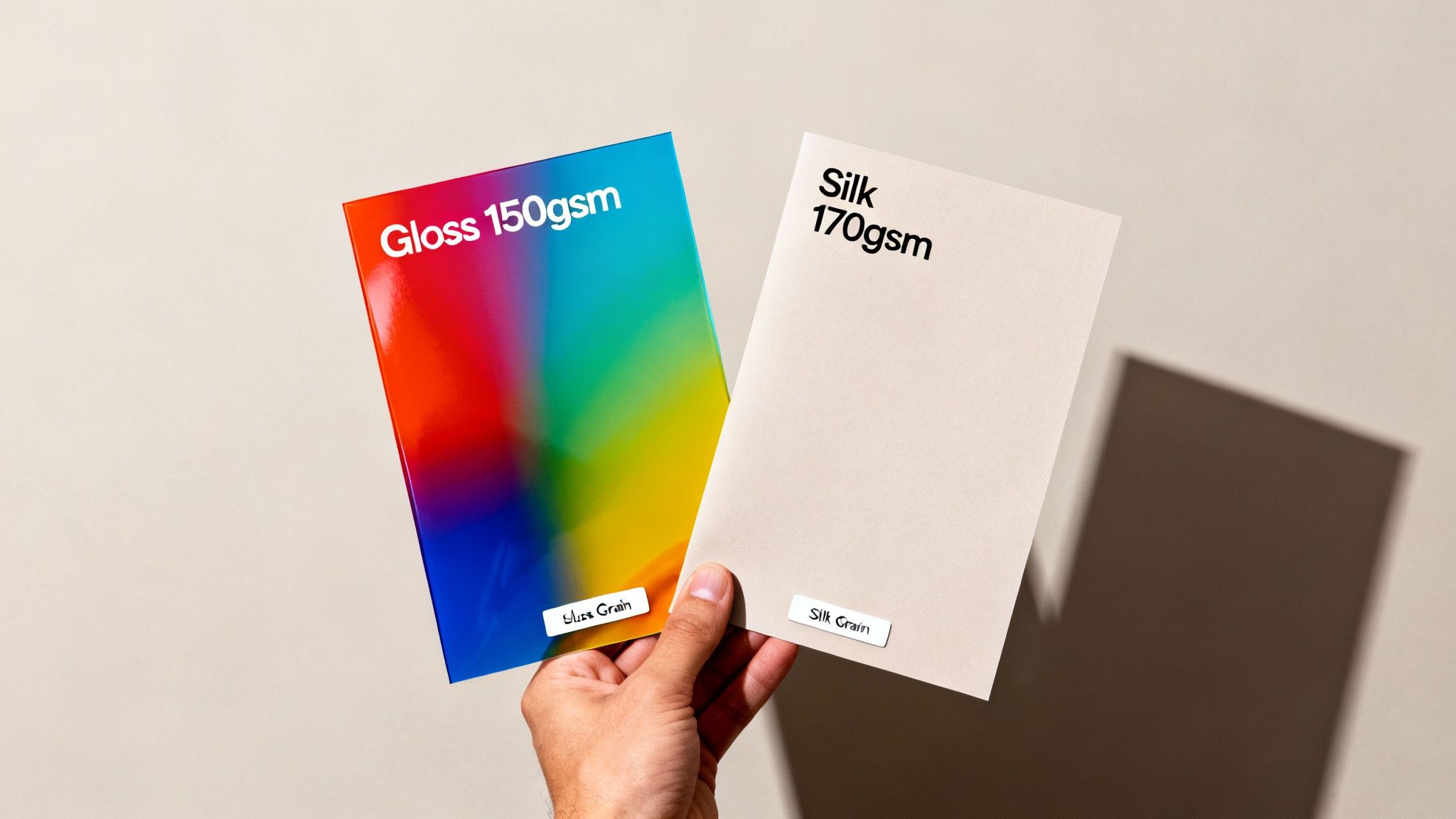
This is where a little product know-how goes a long way. For instance, 150gsm gloss paper is the undisputed workhorse for mass distribution. Think door-drops and event handouts. It’s light enough to keep costs down on huge orders, and the gloss finish makes colours pop, grabbing attention instantly.
Paper Weight and Finish The Smart Way
If you’re after a slightly more premium feel without a massive price jump, have a look at 170gsm silk. The finish is smooth and subtle, feeling more tactile and sophisticated in the hand. It’s an excellent choice for businesses wanting to project a sense of quality—think boutique hotels, design agencies, or financial advisors.
It's also worth noting that sustainability is a huge factor for UK customers now. The print-on-demand market was valued at around $508 million in 2023 and is only getting bigger. This has pushed printers to offer more eco-friendly materials, so always check for recycled paper options if that aligns with your brand values.
Real-World Example: An estate agent needs leaflets for a letterbox drop. They want to look professional but can’t overspend. By choosing 170gsm silk, their leaflets feel more substantial than their competitors' flimsy gloss flyers, making a much better first impression for just a tiny extra cost per leaflet.
Matching Size to Purpose
The size of your leaflet should be dictated entirely by its content and how you plan to get it into people's hands. Get this right, and you'll get cheap leaflets printing in the UK without having to sacrifice your message.
- A5 (148 x 210mm): The classic all-rounder. It’s perfect for in-store handouts, event promotions, or informational leaflets where you need a decent amount of space for text and images.
- DL (99 x 210mm): The letterbox champion. That tall, slim profile fits perfectly into standard envelopes, making it ideal for direct mail campaigns, price lists, or takeaway menus.
- A6 (105 x 148mm): The postcard size. It’s brilliant for short, punchy messages, vouchers, or appointment cards that people can easily tuck into a wallet or pocket.
And if a single sheet just won't cut it? Don't forget the power of a fold. For more complex messaging, check out our options for high-quality folded leaflets. They let you pack in loads of detail without overwhelming the reader.
Ultimately, the key to a successful and affordable print run is aligning your leaflet's purpose with the most economical specs. By choosing the right paper, finish, and size from the start, you can create a powerful marketing tool that delivers maximum impact without blowing your budget.
Preparing Artwork to Avoid Costly Reprints
Nothing torpedoes your budget faster than having to fix and resubmit a print file. It’s a classic trap: a rejected file doesn’t just cause delays, it often racks up unexpected reprint costs. Suddenly, your quest for cheap leaflets printing UK has become a frustratingly expensive ordeal.
The good news? Getting your artwork print-ready the first time is one of the easiest ways to keep costs down, and you don’t need to be a design guru to pull it off. By understanding a few technical essentials, you can make sure your file sails through pre-press checks without a hitch. These aren’t just arbitrary rules—they’re fundamental to turning a design on your screen into a crisp, professional leaflet in your customer’s hand.
Getting the Three Core Elements Right
Think of these three pillars as the non-negotiable foundation of any print-ready file. Get one of them wrong, and the final result will almost certainly be a letdown.
-
Bleed is Non-Negotiable: Commercial printers trim huge stacks of paper at high speed. A tiny, fractional shift in the cutting blade is inevitable. Without bleed, that tiny shift results in a thin, amateurish-looking white sliver along the edge. You absolutely must add 3mm of bleed on all sides of your artwork, which just means extending your background colours and images beyond the final trim line.
-
Resolution Must Be 300dpi: Images you pull from a website are usually 72dpi (dots per inch) because they need to load quickly. For print, the industry standard is a much sharper 300dpi. If you submit a low-resolution file, your images will come out looking blurry and pixelated, which instantly makes your business look unprofessional. Always start with high-quality photos and graphics.
-
Colours Must Be CMYK: Your screen uses an RGB (Red, Green, Blue) light-based model to show you colours. Printing presses use a CMYK (Cyan, Magenta, Yellow, Key/Black) ink-based process. If you upload an RGB file, the printer's software will automatically convert it, and the colours can shift dramatically. To keep your brand colours looking the way you expect, always design in or convert your file to CMYK before you upload.
A common mistake is assuming that the vibrant electric blue you see on your monitor will look the same in print. The RGB colour range is much wider than CMYK, meaning some bright screen colours simply cannot be reproduced with ink.
Use Templates for a Foolproof Setup
Honestly, the simplest way to guarantee a perfect setup is to just use a pre-made template. Any good printer including us at The Print Warehouse Ltd provides free templates for all their products. These files are already built with the correct dimensions, bleed area, safety margins, and colour profile. You just drop your design in.
This image gives you a clear visual guide, showing the difference between the bleed area, the final trim line, and the "safe zone" where you should keep all your important text and logos. Following these guides ensures no critical information gets accidentally chopped off during finishing. Using a template is like having a professional guiding your setup, making it an essential first step when ordering our high-quality, cheap flyers.
If you’re still feeling out of your depth, it might be worth getting professional graphic design assistance to prepare your artwork. An expert will get all the technical specs right the first time, saving you the headache and potential costs down the line. A little prep work goes a long way in making sure your marketing materials create a brilliant first impression.
Unlocking Lower Prices With Smart Ordering
To get properly cheap leaflets that UK businesses can count on, you need to start thinking like a seasoned print buyer. It's not just about the specs you pick, but how you place your order. The smartest marketers know that quantity and timing are the two biggest levers you can pull to slash costs.
The biggest factor by a mile is economies of scale. Think about it: a huge chunk of the cost is in the initial setup—getting the plates ready and calibrating the big litho press. That setup cost is pretty much fixed, whether you're printing 1,000 leaflets or 10,000. This is why the price-per-leaflet absolutely plummets as you order more.
Here's a quick look at how that plays out.
Cost Per Leaflet vs Quantity (A5, 150gsm Gloss)
The table below gives a simple example of how dramatically the unit price drops when you increase your order.
| Order Quantity | Total Cost (Example) | Cost Per Leaflet |
|---|---|---|
| 1,000 | £50.00 | 5.0p |
| 5,000 | £125.00 | 2.5p |
| 10,000 | £200.00 | 2.0p |
| 20,000 | £360.00 | 1.8p |
As you can see, jumping from 1,000 to 10,000 leaflets doesn't multiply the cost by ten. You get ten times the marketing material for only four times the price, which completely changes the return on your investment.
The Trade-Off Between Speed and Savings
Another thing to get right is the turnaround time. I know it’s tempting to hit that "24-hour delivery" button, but a little patience really does pay off.
When you give us a longer production window (say, 5-7 working days), you give us flexibility. It means we can group your job with other similar orders on the same large press sheets. This cuts down on paper waste and machine downtime, and those savings get passed straight on to you. If your campaign isn't urgent, choosing a standard turnaround is one of the easiest wins for your budget.
Key Takeaway: Always look at the price-per-leaflet, not just the total cost. You'll quickly see the massive value in ordering a larger quantity if your campaign can support it.
Getting your artwork right from the start is another massive part of keeping costs down and avoiding frustrating delays. This infographic covers the absolute essentials.
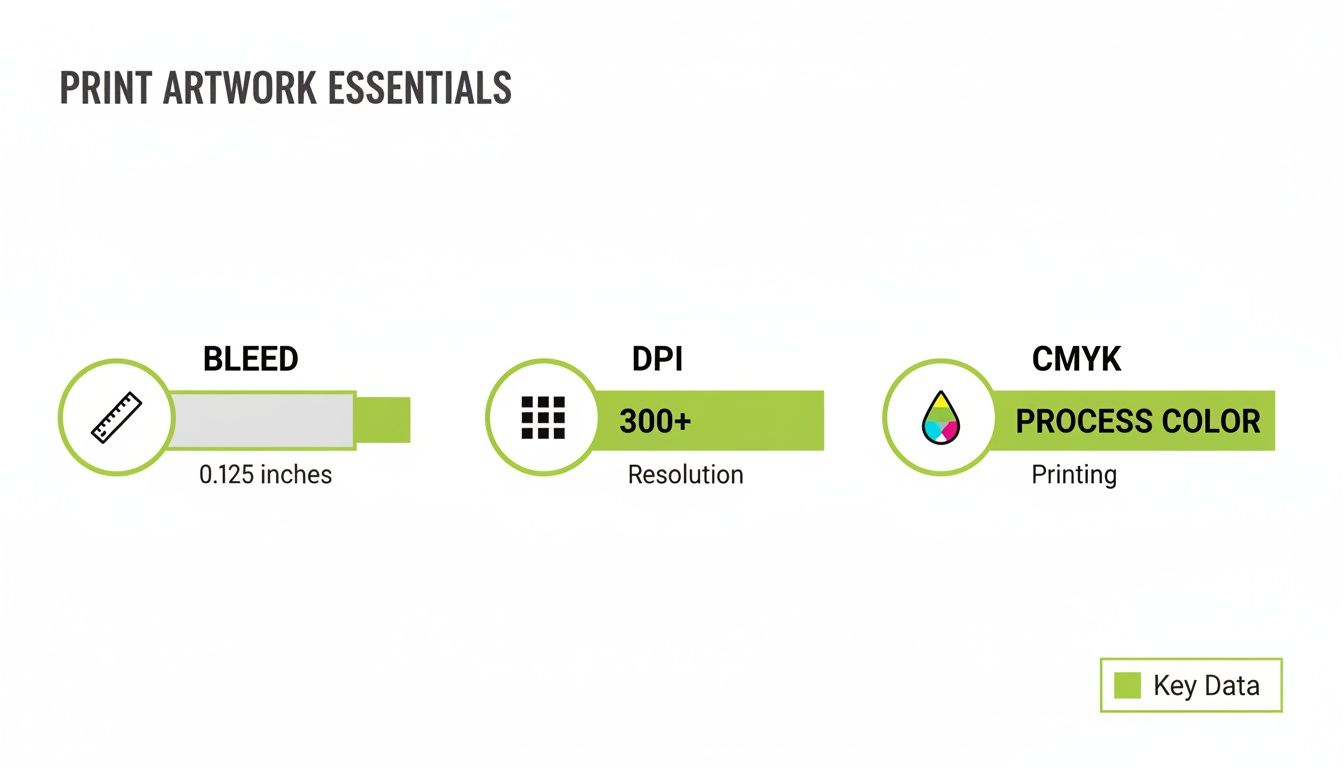
Nailing these technical bits means your order sails through without any costly reprints.
Be Proactive with Promotions and Planning
Finally, a bit of forward planning goes a long way. A simple but effective trick? Sign up for your printer’s newsletter. You’ll be the first to know about seasonal promotions, flash sales, and discount codes that don’t get advertised anywhere else.
This kind of planning taps into why print is still so powerful. Don't just take my word for it—recent surveys show that 33% of UK consumers still enjoy getting printed catalogues and mail. People still value something tangible, which is why a well-planned leaflet campaign remains a brilliant marketing tool.
To squeeze even more value from your order, learn how to master double-sided printing like a pro to cut down on paper. And if you want to shout about your green credentials, have a look at our cost-effective recycled flyers to align your marketing with your brand values.
Combine bulk ordering, flexible timing, and a sharp eye for a deal, and you'll make your marketing budget work much, much harder.
Putting It All Together with The Print Warehouse
All the theory and cost-saving tips are great, but seeing them in action on a real printing platform is where it all clicks. Let's walk through how to take those strategies and turn them into actual savings on your next leaflet order.
Modern online printers are built to give you control, and the most powerful tool at your disposal is the instant price calculator. Think of it less as a final checkout step and more as a live-action experiment. You can see, in real-time, how swapping from a premium 170gsm silk to a workhorse 150gsm gloss paper impacts the price. Or, even better, watch how bumping your order from 5,000 to 10,000 leaflets makes the cost-per-leaflet plummet.
Navigating the Platform for the Best Price
An ordering platform like The Print Warehouse Ltd is designed to be straightforward. As you move through the options—selecting size, paper, and quantity—the price updates with every single choice you make. No hidden costs, no surprises.
Here’s a look at a typical ordering interface. You can see just how easy it is to adjust every variable.
Notice how everything from the size to the paper stock is clearly laid out. This setup puts you in the driver's seat, letting you build the exact leaflet you need while keeping one eye firmly on the budget.
Once you’ve dialled in your specs, the next make-or-break step is the artwork. Instead of starting from scratch and guessing where the bleed or safety zones should be, find the 'Artwork Templates' link. These pre-built files (usually for Adobe Illustrator or InDesign) have all the technical bits—like the crucial 3mm bleed—already sorted for you. Trust me, using one of these is the single best way to avoid the costly reprints we warned you about earlier.
Insider Tip: Always check the delivery options carefully. You'll often find a standard turnaround (say, 5-7 working days) alongside a pricier express option. Unless you're genuinely up against a deadline, simply choosing the standard delivery can shave 10-15% off your total cost. It just gives the printer more flexibility to run your job efficiently.
Finalising Your Order with Confidence
The last part is simple: upload your finished artwork and pop in your delivery details. A good platform will run an automated pre-flight check on your file, flagging any obvious problems like low-resolution images or missing bleed. It's a handy final safety net.
By actively playing with the price calculator and always using the provided artwork templates, you shift from just buying print to sourcing it strategically. This hands-on approach is the secret to getting fantastic quality without a frightening bill, ensuring your leaflet campaign gets off to the most economical start possible. This is how you make an online print platform really work for you.
Got Questions About Leaflet Printing?
To wrap things up, let's dive into some of the most common questions we get asked day in, and day out. Getting these details right from the start can be the difference between a smooth, successful print run and a frustrating reprint.
Our goal here is to give you quick, straight-to-the-point answers so you can place your order with complete confidence.
What’s the Best Paper for Cheap but Professional Leaflets?
For the vast majority of campaigns, 150gsm gloss paper is the sweet spot. It's got enough weight to feel substantial in someone's hand—it won't feel flimsy or cheap—but it's still light enough to be incredibly cost-effective for big print runs, like a local door-drop or an event handout.
The gloss finish is another big win for marketers on a budget. It makes colours pop and gives your design a vibrant, eye-catching sheen without you having to spend a penny extra on special finishes. It’s our go-to recommendation for maximum impact at a great price.
How Much Bleed Does My Artwork Really Need?
This one’s a hard and fast rule: you absolutely need 3mm of bleed on all sides. It’s the non-negotiable UK industry standard for a reason. Think of it as a safety net for the guillotining process. When thousands of leaflets are trimmed at high speed, the cutting blade can shift by a fraction of a millimetre.
Our Top Tip: Always, always extend your background colours, patterns, and any images that touch the edge right into that 3mm bleed area. It’s the single easiest thing you can do to guarantee your leaflets have a clean, professional edge, with no nasty white slivers.
Is It Cheaper to Print on Just One Side?
This is a classic misconception we hear all the time. It seems logical that using less ink would mean a lower price, but in reality, the cost difference between single and double-sided printing is often tiny—sometimes just a few pounds. The real costs in printing are the paper and the time it takes to set up the litho press, not the amount of ink.
When you think about the huge amount of extra marketing space you get, printing on both sides almost always delivers a far better return on your investment. You essentially double your advertising real estate for a tiny extra cost. We always suggest getting a quote for both to see the value for yourself.
Can I Just Send My Artwork in RGB?
Please don't! You should always aim to send your artwork in CMYK (Cyan, Magenta, Yellow, Key/Black). The reason is simple: your screen creates colour with light (Red, Green, Blue), while a printing press uses ink (Cyan, Magenta, Yellow, Key/Black). They are two completely different ways of making colour.
If you upload an RGB file, our system will have to convert it to CMYK automatically. This conversion process can lead to some disappointing surprises—those vibrant electric blues on your screen might turn out a bit dull, or your bright greens might look muted. To get the most accurate and predictable colour in your final print, do the conversion to a CMYK profile in your design software before you upload.
Ready to put all this knowledge into action? See just how affordable high-quality leaflets can be by getting an instant quote from The Print Warehouse Ltd. We make it simple to get the professional marketing materials you need, delivered fast, anywhere in the UK.
Share with Friends & Family:
Related Blogs:
Featured Products: