A Guide to Cheap Leaflet Printing UK Without Sacrificing Quality
Published on
Getting cheap leaflet printing in the UK isn't about just finding the rock-bottom price. It’s about being clever with your choices—balancing paper quality, order size, and turnaround times to get a professional leaflet that actually fits your budget. Sticking to standard sizes like A5 and planning ahead are your two best tools for saving money.
How to Find Affordable UK Leaflet Printing That Works
Let's walk through how to get cheap leaflet printing in the UK without ending up with something you're embarrassed to hand out. The real secret isn't just chasing the lowest price tag; it's about making smart, strategic choices that give you the best bang for your buck. This guide will take you through the decisions that have the biggest impact on your wallet, from picking the right paper weight to understanding how your order quantity changes everything.
We'll look at how simple design tweaks can trim your costs and why planning ahead is your ultimate weapon for savings. Think of this as your roadmap to producing effective, professional-looking leaflets that respect your marketing budget.
Your Strategy for Cost-Effective Printing
Nailing a great price involves more than a quick Google search. It takes a balanced approach where you weigh up all the different factors that influence the final cost. Your goal is to find that perfect sweet spot between quality, speed, and affordability.
The most common mistake I see businesses make is focusing purely on the "price per leaflet" without seeing the bigger picture. Sure, you can save a few quid on thinner paper, but a slightly more expensive, heavier stock might deliver a much better return if your leaflets are for a high-end trade show. On the flip side, a basic, lightweight paper is absolutely perfect for a massive letterbox drop.
Here’s what this guide will help you master:
- Navigating Paper & Finishes: We'll demystify terms like GSM and explain when a gloss or matt finish is worth the extra few pennies.
- Choosing Quantities Wisely: You’ll learn the difference between digital and litho printing and how your order size dictates the cheapest method.
- Optimising Your Design: Discover how standard sizes and print-ready artwork can stop unexpected fees from creeping in.
- Leveraging Time: Understand why a little patience with turnaround times can unlock some serious discounts.
Leaflets are a tangible piece of your brand. Getting the printing right means your message feels as good as it looks, creating a stronger connection with potential customers without overspending.
Beyond just finding cheap printing, it helps to see how your leaflets fit into your wider marketing. For instance, understanding the advantages of content marketing gives you context on how physical media like this can fuel brand growth. Armed with the right knowledge, you can confidently order custom leaflet printing that actually delivers results.
Decoding Paper and Finishes to Cut Your Costs
The moment someone touches your leaflet, they're forming an opinion about your brand. That physical feel sends a powerful, unspoken message. This is why choosing the right paper and finish is such a big deal—it massively influences both the final cost and how people see your business. Let's break down the essentials in plain English so you can find that sweet spot for your budget.
This decision is more important than ever. The UK's custom printing industry, which includes leaflet printing, was worth around £1.7 billion in 2023. That figure is expected to more than double to £3.6 billion by 2030, thanks to new tech and a huge demand for personalised marketing. You can dig into the data on the UK custom printing market growth to see just how fast things are moving.
What Is Paper Weight, or GSM?
The term you'll see everywhere is GSM, which stands for Grams per Square Metre. It’s simply a measure of paper density—the higher the GSM number, the thicker and heavier the paper. This one choice has a huge impact on your hunt for cheap leaflet printing in the UK.
A lower GSM paper is thinner, more flexible, and crucially cheaper. On the flip side, a higher GSM stock feels more substantial, durable, and premium. There’s no single "best" option; it all comes down to what you're trying to achieve.
- 130gsm Paper: This is your classic, cost-effective workhorse. It’s lightweight but still looks professional, making it perfect for big print runs like mass mail drops or newspaper inserts where getting the numbers out is the main goal.
- 170gsm Paper: Here you get a noticeable step up in quality. It feels sturdier and more solid in the hand, hitting a great middle-ground for handouts at events, in-store promos, or for leaflets that need to survive being passed around a bit.
Think of it like this: a local takeaway pushing a weekly special to thousands of homes will do just fine with a lightweight 130gsm paper. It gets the job done without draining the budget. But if you're a high-end estate agent presenting property details, a 170gsm or even a 250gsm paper sends a message of quality and permanence.
How Finishes Affect Your Price (and Perception)
The finish is the coating applied to the paper after printing. It’s there to protect the ink, make your design shine, and add a specific tactile quality. While finishes do add a little to the cost, they can dramatically lift the perceived value of your leaflet.
The Most Common Finishes:
- Gloss: This gives you a shiny, reflective surface that makes colours look punchy and vibrant. It’s a brilliant choice for designs heavy on images—think travel agents or photographers—as it really makes photos pop.
- Silk (or Satin): Sitting somewhere between gloss and matt, silk is a smooth, elegant finish with a subtle sheen. It adds a touch of class without the full-on reflection of gloss, so text is still very easy to read. It's an incredibly popular and versatile all-rounder.
- Matt Lamination: For a non-reflective, soft, and modern look, matt is the way to go. It’s often used to give off a sense of luxury and quality. While it can make dark colours seem a bit more muted, it’s a premium option that feels great to the touch.
- Uncoated: Just as it sounds, this paper has no coating at all. It has a natural, porous texture that’s easy to write on, making it perfect for things like feedback forms or appointment cards. If you're after a simple, budget-friendly option, our range of uncoated flyers are ideal for straightforward, no-fuss marketing.
The right finish can be the difference between a leaflet that gets a quick glance and one that gets kept. Consider your brand's personality—is it bright and energetic (gloss), or refined and elegant (matt)?
To help you visualise the trade-offs, here’s a quick look at how these choices stack up against each other.
Paper Weight and Finish Cost Comparison
| Paper/Finish Option | Typical Use Case | Perceived Quality | Relative Cost |
|---|---|---|---|
| 130gsm Gloss | Mass door drops, event handouts | Standard, professional | £ |
| 170gsm Silk | In-store promotions, business handouts | High quality, substantial | ££ |
| 350gsm Matt | Premium marketing, business cards | Luxury, durable | £££ |
| Uncoated | Forms, vouchers, rustic designs | Natural, writable | £ |
As you can see, you don't always need the most expensive option. The key is aligning your choice with your campaign's objective to get the best value for your money.
Making the Smart Choice for Your Campaign
So, how do you pull this all together to get the best deal? It’s all about matching the paper and finish to the specific job your leaflet needs to do. It’s a waste of money to over-engineer a simple door-drop with heavy paper and a fancy finish. But by the same token, skimping on quality for a handout at a major industry conference can make your brand look cheap.
Let’s look at a real-world scenario: a new local coffee shop wants to promote its grand opening.
- Mass Letterbox Drop: They need 10,000 A5 leaflets to blanket the local neighbourhood. The smart move here is 130gsm gloss paper. The lightweight stock keeps the cost per unit right down, and the gloss finish will make the photos of their coffee and pastries look irresistible.
- In-Store Counter Display: For the counter, they need 500 leaflets explaining their loyalty programme. Here, 170gsm silk is a much better fit. It feels more durable, looks professional, and will stand up to being handled by customers all day long.
By splitting their order this way, the coffee shop gets the best of both worlds. They achieve maximum reach for a low cost on the mass campaign, while using a higher-quality material to represent their brand in-store. This kind of strategic thinking is the secret to getting effective leaflet printing without overspending.
Choosing the Right Print Method for Your Budget
When you’re hunting for cheap leaflet printing in the UK, the single biggest factor that will move the needle on your bill is the printing technology. Your two main options are digital and lithographic (often just called litho).
Picking the right one isn't about which is "better"—it's about matching the tech to your order size to get the best price per leaflet.
Getting this right is crucial. The commercial printing market in the UK, which includes things like leaflets and brochures, is a massive £9.3 billion industry. Some projections even show it growing to around £24 billion by 2030. In such a competitive space, understanding where the savings are is everything.
When Digital Printing Is Your Best Friend
Think of digital printing as the fast, flexible, and budget-friendly choice for smaller jobs. It works a bit like a high-end office printer, taking your design file and printing it directly onto the paper.
The big win here is the minimal setup. There are no expensive printing plates to create, which makes it perfect for short runs. If you just need a few hundred leaflets to test a new offer or promote a local event, digital is almost always the most sensible way to go.
- Best for Quantities: Generally, anything under 500-1,000 leaflets.
- Key Advantage: Low setup costs keep small batches affordable.
- Speed: It’s incredibly fast, so quick turnarounds are no problem.
- Flexibility: You can even do variable data printing, where every leaflet is unique (like personalising them with a name).
Imagine a local cafe owner printing 250 A5 leaflets for a weekend special. With digital, the cost is manageable, and they can have them in a day or two. If they tried to get that small a quantity printed with litho, the setup costs alone would make each leaflet eye-wateringly expensive.
The Power of Litho for Bulk Orders
Lithographic printing is the traditional powerhouse of the industry, built for one thing: efficiency at scale. This method involves creating custom metal plates from your design, which are then used to transfer ink to paper.
The initial setup takes more time and money, which is why it’s a non-starter for small orders.
But once that press starts running, the cost per leaflet drops like a stone. The more you print, the cheaper each one gets. This is where you find the real savings for big campaigns. It’s a different way of thinking, but just as important as knowing how to decide between flyers or leaflets for your campaign.
For any print run of several thousand or more, litho printing will almost always give you a much lower price per unit. The setup cost gets spread so thinly across the large quantity that it barely registers.
This simple flowchart shows how your goal might point you towards one method over the other.
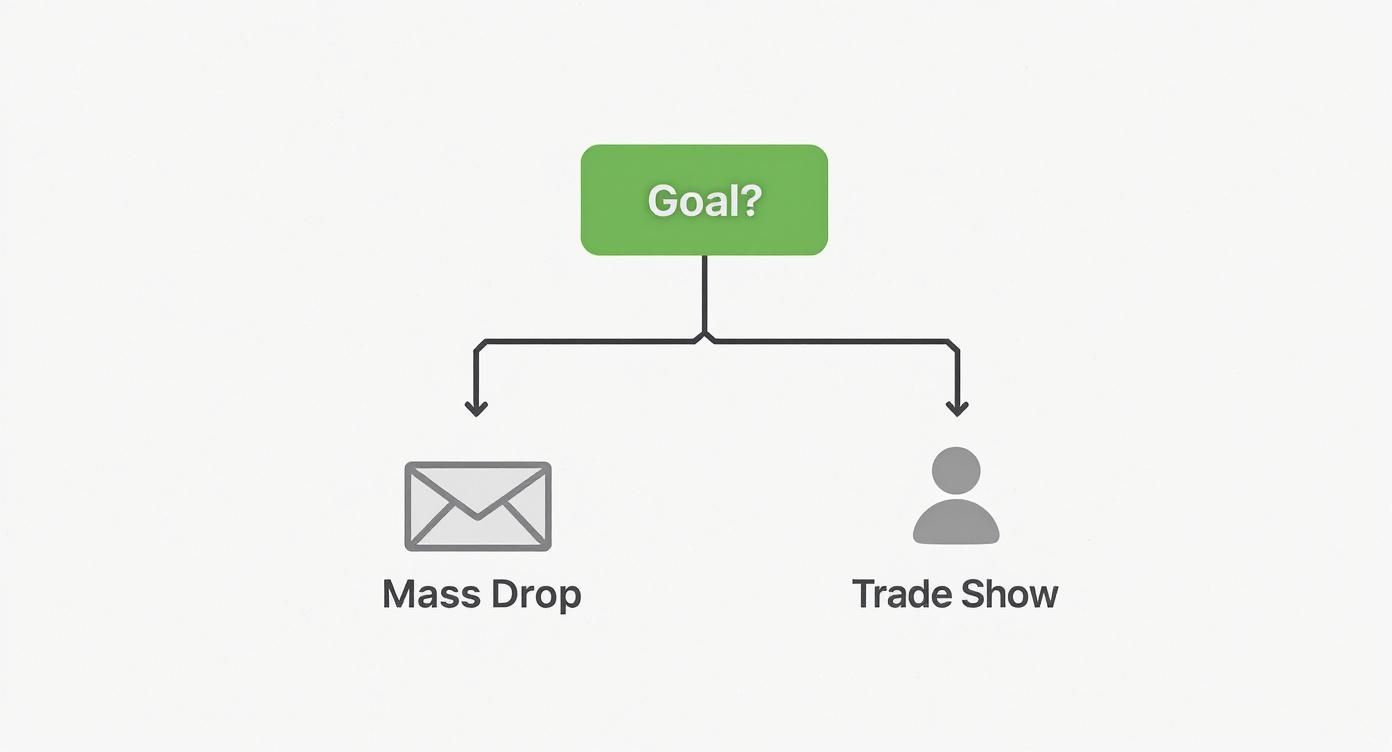
As you can see, a mass distribution campaign has totally different needs—and different cost-saving opportunities—than a targeted handout at a trade show.
A Real-World Cost Comparison
Let’s go back to our cafe owner. This time, they’re planning a big three-month marketing push and need 10,000 leaflets to drop through letterboxes across several postcodes.
- Digital Printing Scenario: Printing 10,000 leaflets digitally would mean the cost per unit stays pretty flat. The total might be around £250, making each leaflet cost 2.5p.
- Litho Printing Scenario: With litho, the price per unit plummets at this volume. The same 10,000 leaflets could cost around £150, bringing the price down to just 1.5p each.
That’s a 40% saving just by picking the right print method. For bigger runs of 20,000 or 50,000, the savings with litho become even more dramatic.
Making the Economical Choice
So, how do you decide? It all comes down to your numbers.
Thankfully, online print shops have made this super easy. When you type your quantity into their online calculator, the system usually works out the most cost-effective method for you behind the scenes.
But as a quick rule of thumb, here’s how to think about it:
| Quantity | Recommended Method | Why It's Cheaper |
|---|---|---|
| 1 - 1,000 | Digital | You avoid the high setup costs of litho, making small runs affordable. |
| 1,000 - 5,000 | Check the Quote | This is the crossover zone. Compare prices, as either could be cheaper. |
| 5,000+ | Litho | The incredibly low cost-per-unit at high volumes delivers massive savings. |
By understanding this fundamental difference, you can make sure you’re not overpaying. You’re simply aligning your project’s scale with the technology designed to handle it most efficiently—the smartest way to get cheap leaflet printing for any campaign, big or small.
Smart Design Choices That Save You Money
Your design file is the blueprint for your leaflet, and the small choices you make here can have a surprisingly big impact on your final bill. Getting your artwork right from the start is genuinely one of the most effective ways to secure cheap leaflet printing in the UK. Why? Because it helps you sidestep frustrating—and costly—delays or rejection fees from your printer.
This isn't about compromising on creativity; it's about being technically smart. By following a few simple rules, you can make sure your file sails right through the pre-press checks, saving you both time and money.
Stick to Standard Sizes
The easiest win for your budget is to design for a standard paper size. Printers buy paper in enormous sheets and then cut them down to the final product size. Their entire workflow—from the presses to the guillotines—is optimised for standard dimensions like A5, A6, and DL.
If you request a custom size, you’re essentially asking for a special process. This often involves extra cutting and generates more paper waste, and you can bet the printer will pass that additional cost straight on to you. Sticking to a standard size means your job fits perfectly into their efficient system.
Create Print-Ready Artwork Every Time
Printers have a technical checklist that every single design file has to pass before it can go to print. If your file fails any of these checks, it gets kicked back. Many online printers will then charge a fee to either fix the file for you or for the time spent handling your re-submission.
Here’s a simple checklist to follow to avoid those pesky fees:
- Set Resolution to 300dpi: DPI means Dots Per Inch. For anything printed, 300dpi is the non-negotiable industry standard for sharp, clear images. Files with lower resolutions (like 72dpi, which is fine for web images) will look blurry and pixelated in print.
- Use CMYK Colour Mode: Your computer screen uses an RGB (Red, Green, Blue) colour model, but printing presses run on CMYK (Cyan, Magenta, Yellow, Black). If you design in RGB, you’re in for a surprise when the colours look different in the final print. Designing in CMYK from the get-go ensures what you see is much closer to what you get.
- Add 3mm of Bleed: Bleed is a little margin of your design that extends past the final trim edge of the leaflet. Since it's impossible to cut paper with perfect microscopic precision, the bleed ensures that if the cut is a fraction of a millimetre off, you won’t have an ugly white sliver along the edge of your design.
- Keep Text in a Safe Zone: Just as you add bleed on the outside, you need a "safe zone" on the inside. Keep all your important text and logos at least 5mm away from the trim edge. This stops anything critical from being accidentally chopped off.
Think of print-ready artwork as speaking the printer's language. When you provide a file that meets their technical specs, you remove any friction from the process, which translates directly into faster production and lower costs.
Just as a good website layout is crucial, applying expert strategies for building high-converting designs can make your leaflet far more effective. A well-organised design isn't just about looks; it's about efficiency. For instance, if you're working with a more complex layout, exploring options for folded leaflets can give you more space while still being based on a standard, cost-effective sheet size.
Unlock Savings with Smart Ordering Habits
Beyond the design file itself, how you place your order can unlock even more discounts. Online printing is a game of efficiency, and printers absolutely reward customers who help them streamline their operations.
One of the biggest insider tips is to play around with the turnaround time. If you aren’t in a massive rush, choosing a longer production time (say, 5-7 working days instead of next-day) can often slice a significant chunk off your bill. This gives the printer the flexibility to "gang-run" your job—printing it alongside other orders on the same big sheet of paper to minimise waste and setup time. They pass those savings right back to you.
Another savvy move is to bundle your print jobs. If you know you'll need leaflets, business cards, and posters over the next couple of months, order them all at once from the same printer. You'll save on consolidated delivery fees and might even be able to get a better rate for the larger order. A little bit of planning ahead is your most powerful tool for cutting costs.
How Turnaround Time and Delivery Affect Your Final Price
In the world of online printing, one of the biggest secrets to saving money has nothing to do with paper or design—it's all about time. Your patience can be profitable. The speed you need your leaflets printed and delivered has a direct, and often significant, impact on your final invoice. Planning ahead is your most powerful tool for unlocking the best prices.
This dynamic exists within a huge and competitive sector. The UK printing industry is a massive part of the economy, with a market size estimated at £9.2 billion and home to around 7,802 businesses as of 2025. You can get more insights into the UK's vibrant printing industry to see how printers compete for your business, often by optimising their production schedules.
Why Longer Turnarounds Mean Bigger Savings
Ever noticed how online print shops offer hefty discounts if you’re willing to wait a few extra days? There’s a clever reason for that. Opting for a standard turnaround of 5-7 working days instead of a rush next-day service allows the printer to be far more efficient with their resources.
This extra time gives them the flexibility to perform what’s known in the trade as a gang-run print. Instead of setting up a massive printing press just for your job, they can group your leaflets with orders from several other customers onto a single, large sheet. This simple step drastically reduces setup time, minimises paper waste, and makes the entire operation more cost-effective.
Those savings are then passed directly on to you as a discount. A next-day service, on the other hand, forces them to prioritise your job, often requiring a dedicated press run which is far less economical.
Choosing a longer turnaround time is the easiest win when you're looking for cheap leaflet printing in the UK. If your deadline allows, selecting the 5-7 day option can often save you 20-30% compared to an express service.
Navigating UK Delivery Options for Your Budget
The second part of the timing equation is delivery. Once your leaflets are printed, boxed up, and ready to go, the shipping method you choose will add to the final cost. And just like with production, speed comes at a premium.
Thinking about your campaign timeline in advance is crucial here.
- Standard Delivery (2-3 Days): Services like Royal Mail or other standard couriers offer reliable delivery at a reasonable price. This is the go-to option for most budget-conscious orders.
- Next-Day Delivery: If you absolutely need your leaflets urgently, guaranteed next-day services are available but will cost you more.
- Pre-Noon or Saturday Delivery: These premium options offer even more specific delivery windows but come with the highest price tags.
Let’s run through a real-world scenario. Imagine you need flyers for an event on a Friday. If you order them with a standard turnaround the week before, they’ll be ready for dispatch by Monday or Tuesday. You can then choose a standard 2-3 day delivery, and they’ll arrive with plenty of time to spare, all while keeping costs low.
But if you leave it until Wednesday, you'll be forced into express production and premium next-day delivery, potentially doubling your total spend. Our guide to ordering flyers can help you plan the whole process from start to finish.
Your Final Checklist Before Placing an Order
Right, before you hit that big green "Order Now" button and part with your hard-earned cash, let's take one final look. Think of this as your last line of defence – a quick sanity check to catch any silly mistakes that could cost you time and money.
Going through these points will only take a minute, but it could save you the headache of a costly reprint or the panic of a missed deadline. It's always worth it.
Artwork and Specifications
First up, let's talk about your design file. Getting the technical specs wrong is one of the most common reasons for print jobs getting delayed or rejected. A simple slip-up here can add unexpected costs, which is the last thing you want.
- File Format: Have you saved your design as a high-quality PDF? It’s what nearly every printer prefers.
- Resolution: Are all your images crystal clear? Check they’re set to 300dpi to avoid any fuzzy, pixelated results.
- Colour Mode: Is your file set up in CMYK? Submitting an RGB file (meant for screens) can lead to some very disappointing colour shifts when it’s printed.
- Bleed and Safe Zone: Does your artwork extend 3mm beyond the trim edge on all sides (the bleed)? And is all your important text and imagery tucked safely inside the "safe zone"?
Cost and Delivery Sanity Check
Once you're confident the artwork is spot on, give the order details a final once-over. This is where a bit of flexibility can make a real difference to the final price.
One last look is never a waste of time. Catching a single typo or realising you've selected express delivery when standard would do just fine can save you both money and embarrassment.
Have you confirmed the following?
- Paper Choice: Is that 130gsm gloss paper genuinely the best and most cost-effective choice for what you're trying to achieve with this campaign?
- Quantity vs. Method: Does your order size make sense for the print method? Remember, digital is your friend for small runs, but litho printing is where you’ll see big savings on bulk orders.
- Turnaround Time: Have you picked the slowest production time you can get away with? Seriously, this is often the single biggest money-saver. If you don't need them tomorrow, don't pay for it.
- Final Proof: Most importantly, have you looked at the on-screen proof one last time? Read every single word. Check every image. Is everything exactly where it should be?
Running through this final review should give you total peace of mind. You can place your order knowing you’ve done everything possible to get the best deal and that your leaflets will arrive looking exactly as you imagined.
Got Questions About Leaflet Printing? We've Got Answers
Getting into the nitty-gritty of online printing can bring up a few last-minute queries. But getting clear, straightforward answers is key to placing your order with confidence and knowing you’ve snagged the best deal.
Here, we’ll tackle some of the most common questions that pop up when ordering cheap leaflets in the UK. Think of it as your final check-in before you hit "confirm".
What Is the Best Paper for Cheap Leaflets?
The honest answer? The "best" paper really depends on what your leaflet needs to do. If you're planning a massive letterbox drop, you need something that’s easy on the budget but still looks sharp. For that, a lightweight 130gsm gloss paper is a brilliant choice. It’s affordable in bulk, and that glossy finish makes colours pop.
However, if your leaflets are for an in-store display or an event where they’ll be handled, it’s worth stepping up to a slightly thicker 170gsm silk stock. It offers much better durability without a huge price jump and just feels more substantial in the hand, striking a perfect balance between quality and cost.
Can I Design My Own Leaflets to Save Money?
Absolutely! You don’t need to be a professional graphic designer these days to create something that looks great and gets results. Many people use free online tools like Canva, which is packed with customisable templates built specifically for print.
Using a template is a smart move for two big reasons:
- It saves you the cost of hiring a designer, which can be a significant chunk of your budget.
- It ensures the technical specs—like the size, bleed, and resolution are spot on from the get-go, helping you avoid frustrating rejection fees from the printer.
Is Printing More Leaflets Always Cheaper?
In a way, yes. The price per leaflet almost always drops dramatically as your order quantity goes up. This is all down to the economies of scale you get with lithographic printing, where the initial setup costs are spread across a larger run.
You might find that ordering 10,000 leaflets only costs a little more than ordering 5,000. This makes your cost-per-unit much, much lower. Always check the price points for higher quantities before finalising your order the value can be surprising.
How Do I Make Sure My Colours Print Correctly?
This is a classic concern, but thankfully, there's a simple fix. The key is to design your artwork using the CMYK colour model (Cyan, Magenta, Yellow, Black), not RGB (Red, Green, Blue). RGB is for digital screens, while CMYK is the industry standard for professional printing presses.
If you send a file designed in RGB, the printer's software has to convert it, and that can cause some unexpected and disappointing shifts in your brand colours. Designing in CMYK from the start gives you a far more accurate preview of how the final printed colours will look, so there are no nasty surprises when you open the box.
Ready to put this advice into action? The Print Warehouse Ltd makes it simple to get high-quality, affordable printing for your next project. Explore our full range of options and get an instant quote today at https://theprintwarehouse.uk.
Share with Friends & Family:
Related Blogs:
Featured Products: